WHERE ON EARTH HAVE YOU BEEN?!

Showing posts with label bus journeys. Show all posts

Sunday, 12 June 2011

Incan mummies and witches, oh my!

Having escaped the protests in Puno, we made it to Arequipa - hurrah! Arequipa is Peru's second-largest city, and the central part that we stayed in was really pretty with huge colonial buildings and plazas filled with pigeons and palm trees. We stayed in a really friendly hostel (Wayra River) that deserves a mention - we could go out and sit on the rooftop outside our room, from which there was a beautiful view of the city and the several snow-capped volcanoes that surround it:
It was also a treat to have come down to a lower altitude, so it was warm and we could put away our woolly hats and gloves for a while! Here is the central square:

We spent a couple of days just recovering in Arequipa which was really nice, but there was one excursion we did that certainly deserves a mention: we visited the 'Museo Santuarios Andinos', a university-run museum, in which there is an exhibition of a 500-year-old Incan mummy that was preserved in the ice at the top of a nearby mountain. She is known as 'Juanita the Ice Maiden', and was a young girl who was sacrificed in the Incan tradition. The exhibition was really fascinating, and included lots of artifacts that she was buried with, such as golden Incan statues (there are not many of these left in the world, as the invading Spanish melted down all the Inca's gold they could find). I wrote a more detailed article on Juanita here for 'Perupedia' (more on this project later).

After a couple of days we headed onwards to Lima (a 15-hour bus journey, but a really comfy one that was probably our best yet - good food, movies, and comfy reclining seats: luxury). We arrived at the apartment that would be our home for the next three and a half weeks, and soon met Julio, who runs the Karikuy project that we would be taking part in. The project involves writing wiki articles for an online database of information on Peru ('Perupedia'), and blogging regularly about stuff we do in Peru. But before we started work in earnest, we went on a two-day trip to Ica, about 5 hours south of Lima. Julio's friends from school in the US were visiting him, and their final couple of days here overlapped with our first few days. We all got on really well, and they invited us along on their final jaunt before they headed home.

Ica is a fairly average city, but just outside it is the oasis town of Huacachina, which is where we stayed. The town has a lake in the middle, and is surrounded by enormous sand dunes on all sides:


The Ica region is also a grape-growing region, where numerous bodegas make wines and pisco, which is a Peruvian grape brandy. We visited a couple of these for a tour and some tasting sessions. At the first bodega, 'El Catador', they have a centuries-old grape press and original clay pots for aging the wines. We learned about the process of making pisco, and then got to try several of the many varieties, along with some locally-made fruit jams. Then we were off to a second bodega, the 'Bodega Lazo', for more tasting. This was an especially characterful bodega, full of historic collectors' items displayed by the owner such as stuffed animals, paintings, pre-Columbian artifacts and Peruvian textiles. The owner poured out the wines and pisco from the ceramic pots using a hollowed out bamboo stick. Here I am trying to sound like I know what I'm talking about:

Now, I should mention that pisco is about 40% alcohol, so after two tasting sessions we were all feeling a bit merry. It seemed like the natural thing to do to buy some more pisco and have a few at the bodega like the locals. Except, we couldn't keep up! The pisco is sold in classy-looking 2-litre plastic bottles - we barely made a dent in it. From left to right, here is Jill, Sal, and Julio next to me:


By this point the sun had set, and we set off on a spooky night-time visit to the nearby village of Cachiche, which is famous for its history of witchcraft. According to legend Doña Julia, Cachiche's first witch, was known to practice good magic, curing and helping villagers with her spells. A nine-year-old boy called Diego materialised out of the darkness to give us an excellent tour of the sights and an account of the legends behind them. The tale that has stuck with me the most is that of the seven-headed palm tree, which we went to see. The story goes that a group of witches chose one among them to be sacrificed in a ritual ceremony. Understandably, the chosen witch disagreed about this, and she ran away towards a nearby palm tree. The other witches chased her, threw a spear, and the palm tree was split into seven parts. The witch leaped from branch to branch, evading her captors, and during the chase one of the seven limbs broke away. The witch made a curse, declaring that if the seventh limb ever grew back, Ica would be destroyed. To this day, the inhabitants of Ica make sure to cut back the seventh limb of the tree (although in 1998 the seventh head started to grow again, and there was serious flooding in the area). The tree is an incredible sight, with many twisting limbs growing out from a single point in the centre at impossible angles:

We also paid a visit to a nearby museum where you can get your fortune told by tarot or by palm reading. I had my palm read, and left assured that I would be around for a long time yet - hurrah! Here is one of the museum's black cats (disclaimer: no animals drank cocktails during the making of this blog):


The next day we headed out into the dunes to try a bit of sandboarding! We hopped into a dune buggy and were driven up and down the steep dunes at breakneck speed - brilliant fun, like a rollercoaster ride!

Our dune buggy:

The dunes stretched on for miles and miles - an amazing sight:


Then we pulled up at the top of our first slope which, incidentally, looked absolutely massive and scary. Without much further ado (and almost no instruction whatsoever), we were told to lie down on our boards and zoom down the slope on our tummies. Here is my first go - the blood-curdling scream is entirely genuine:


This turned out to be brilliant fun and not actually that scary, so we drove around to a few more increasingly high slopes and did more of this for a while before rushing back to Ica to catch our bus home to Lima. The sandboarding was the highlight of our trip to Ica - highly recommended!

Friday, 27 May 2011

Bolivia to Peru: A Border-Crossing Odyssey

The 23rd and 24th May 2011 comprise of 48 hours that Ania and I would probably rather forget. It re-defines the phrase 'difficult border crossing', but I guess there's some comfort to be had in the knowledge that we are not alone in making this epic trip: hundreds and probably thousands of other tourists have had to deal with this in Bolivia and Peru in the past few weeks.

For those of you who don't know: there were major strikes and protests going on at the Bolivian border with Peru, up until last week. All the demonstrations were put on hold because of the election yesterday (5th June) and we're not quite sure what's going on now! At the time though, we knew even less - and anything we did know was hear-say. The biggest issue was anger over a Canadian mining company's plan for a new mine. So there were miners and students protesting, plus I'm sure the usual people without anything to do who like to join in protests (same as in the UK)! I'm all for peaceful protest but I'm sorry to say this wasn't peaceful. So our planned route from Copacabana to Puno - the two towns on either side of Lake Titicaca - was blocked when we wanted to take it. The usual three-hour bus journey was not an option. What follows is what we had to do instead...

We got up at 5:50am on 23rd in order to catch our boat - yes boat - to Peru. We were the first ones to arrive at the tiny shop where we bought our tickets and after some moments of 'Is anyone else coming?...' our group piled into two minibuses and set off for the border. More waiting around and then we got our Bolivian exit stamps pretty quickly once the office opened. The Peruvian side was shut! So now technically not in any country, we walked across boggy ground to our little boat. Our group, 'Grupo de Celia' (named after the woman who sold us the tickets) all got seats, after paying the crew a few Peruvian Soles each. Some others weren't so lucky. That boat was then our world for the next nine and a half hours! Not much to report there, I'm afraid. We read our books (I got through most of The Green Mile by Stephen King) and ate our packed lunch, which we had sensibly packed the previous day!

On arrival in Puno, we all jumped on a bus and were taken as near to the town centre as possible. Vehicles can't go near the blockades, you see. But people can - and go near them we did! We were led through the main square towards the immigration office. We all needed our Peru entry stamps. Our guide led us through the shouting crowd - most of whom just smirked at all the 'gringos' - although a few were intimidating, or at least tried to be. We got our stamps eventually from a very disorganised, ramshackle (and I suspect makeshift) office; and then found our way back to the bus.

Ania and I then bought a bus ticket to Arequipa (our next stop in Peru) for the next day, from the guys on the bus, based on the fact that they'd been so helpful getting us into Peru. This turned out to be a mistake...

We got to our hostel in Puno, 'Los Pinos', at around 7pm and after a quick turnaround, headed out for excellent pizza and a couple of well-earned beers! At one point the protestors rumbled past and the owner of the restaurant closed all the shutters and dimmed the lights. It was like being in a lock-in for ten minutes - except better, because there was also pizza from a proper wood-fire oven! We ate our meal safe in the knowledge that we'd done the hard part!

Or so we thought, but no such luck! The next day, the guy we'd bought our bus ticket from failed to turn up at our hostel for our prearranged pick-up. The woman at the desk in our hostel - who incidentally was super-sweet, very kind and helpful - said she'd heard there were no buses leaving the town. Our hearts sank and we left on foot, eventually catching a rickshaw to the bus station. The terminal was a ghost town and after talking to two policemen, we realised we'd paid well over the odds for our bus tickets: 40 Soles each instead of 15! We gave up trying to get our money back (40 Soles is just under 9 quid - annoying to lose it, but what can you do...) after finding the company's office closed and having no joy phoning the number on our ticket.

With no buses leaving, we instead hooked up with two other couples from Italy and Canada. The plan? To walk out of Puno on foot and catch a bus or taxi to Juliaca, a town just outside of the blockade, from where we hoped to be able to catch a bus to Arequipa.

So off we set, telling our new friends about the dodgy bus tickets. Not even two minutes had passed when who should Ania spot, drinking booze at 8:30 in the morning outside a shack?! The guy who'd sold us the tickets! He looked so busted and we demanded our money back. We got 70 of our 80 Soles back - and had a heated exchange with one of his mates, who stooped so low as to tell us that he hoped the protestors would hurt us. Money safely in hand, we told that arsehole to shut his mouth and walked away! I'm so proud of Ania! She did most of the arguing with her superior Spanish and showed those crooks who was boss!

A few minutes down the road a man approached us and in excellent English told us to make ourselves scarce! He said the protesters were coming and we should sit out of the way - and that he was going to do the same. As he walked away we saw them coming - this is a loud angry mob who haven't just been peacefully marching, they've been throwing stones at vehicles, blocking roads and disrupting tourists (and tourism) for weeks. The six of us sat by the side of the road. A woman then approached. 'You're not safe here,' she said. 'Follow me'. We obeyed and ended up hiding in a public bathroom with her and a couple of other Peruvians! We spent about ten minutes there, during which time the woman advised us to get to a hotel in Puno and wait for a few days! Grateful as we were for the shelter, we decided to leave. The situation hasn't changed in almost a month, why would things be different in a few days?!

With the coast apparently clear we left the bathroom, but then we saw the mob again, coming right for us! We walked quickly, not running, and just managed to avoid them. Thank God they took a different road to us!

We then had to walk for two hours, carrying our 12kg backpacks plus hand luggage, up a massive hill. The roads were covered in rubbish, huge blocks of brick and stone and bits of metal - all designed to stop traffic getting through:

In the middle of this photo you can see a poster for the election campaign of Keiko Fujimori (the election was on Sunday, it looks like she lost). The slogan reads, 'Seguridad y oportunidades por todo' (security and opportunities for all). I liked the irony of the juxtaposition of the poster with the crap all over the road!

It was really tough carrying so much up such a steep incline, but we did it eventually with several rests. Every time we thought we'd made it, there was another section of hilly road! I was not best pleased:


Where we came from. Puno town centre, at the bottom of the first huge hill:

Eventually we were rewarded with clear roads and an estate car. The driver agreed to take us to Juliaca for 25 Soles each. We squeezed in: luggage in the boot, our four new friends in the back and Ania and I sharing the front passenger seat. For two hours! We drove mainly on unsealed, winding roads, but it still beat walking! We made a quick stop at one point. Here we are in the middle of nowhere!
On arrival in Juliaca we caught a four-hour bus (for the correct price of 15 Soles this time!) to Arequipa and a short taxi ride to our hostel. Mission accomplished! A difficult 48 hours to say the least, but we did it! And hey, it makes a great story doesn't it?

Wednesday, 25 May 2011

I'm the Capital of Bolivia! No I Am! No I Am! You Liar! I Am!

I should probably start by explaining that title. Bolivia is a country with a rare situation when it comes to its capital: it has two! Sucre is the constitutional capital, while La Paz is the administrative capital. I get the feeling there's something of a rivalry over their claims to the title, but it seems to be pretty good-natured. Ania and I thought we'd group these two together in a post, especially as we visited them in quick succession.

We spent five days in Sucre at a strange hostel where we at least had a very nice private room. We took some time to relax after the high altitude and sometimes tough conditions we experienced in the Salar de Uyuni and Potosí. Sucre is a beautiful city. It's small and completely walkable, with very Mediterranean-style buildings: white-washed structures with terracotta roofs. It definitely reminded us of Malta in places!

Any regular readers of this blog will know that Ania and I class ourselves as reasonably foody people and are in some ways 'eating our way around the world'! Sucre was one of those wonderful havens for us where we could rest, read our books, walk around the town and... eat! We found several good restaurants within the first couple of days and then revisited our favourites in the second half of our visit. The ones worth mentioning are Locot's, where the menu includes burritos and Indian curry, with veggie versions of both. Very impressive! There was Cafe Monterosso, a hidden gem of a restaurant run from a family's converted living room, where we ate great pasta, baked aubergine and panna cotta. Florin was great too, where on our last morning I got the Bolivian/French influenced version of a Full English breakfast, complete with baked beans (they were also showing Tottenham Hotspur beating Liverpool in the penultimate game of the Premier League, which always helps the food go down!). Finally, there is a little cafe/restaurant (the name of which I don't recall) in the Recoleta area. We ate here twice. It's chief features are excellent fresh fruit juices, tasty pastas and salads, an annoying food-scavenging cat which scratched Ania (!) and fantastic views of the city:

Sucre has a thing for dinosaurs and we didn't really understand why at the time. As I've said, we were busy taking a well-earned breather! A quick Google search tells me that the town is home to the world's largest collection of dinosaur footprints! They're about 60 million years old and were discovered by workers from a cement factory in 1994. Interesting, huh?! During our time in Sucre, we did see that some tour companies offered dino-themed trips, but we didn't know any of the history. Shame on us! Bearing our ignorance in mind, you can imagine our bafflement and amusement when we happened upon statues and other figures, including this delightfully tasteful public telephone outside Sucre's beautiful cemetery:

An interior shot of the aforementioned cemetery. Much like the one we visited in Buenos Aires, its like a beautiful town with the graves and memorials above ground. Below you can see small memorials with glass doors in gold frames. Relatives put flowers and tokens inside. We even saw one with a miniature bottle of beer!

Our next stop was La Paz, which we reached by overnight bus. I certainly won't miss these long journeys, and this wasn't a particularly good one! Ten hours, admittedly helped by the inclusion of our first fully 'cama' (bed) seats, that reclined to a proper horizontal position! The ride was not improved however by the very noisy, very crap movie playing. Although in retrospect I do appreciate the comedy value of The Gods Must Be Crazy II! We arrived in La Paz at about 6am and stayed at the beautiful Cruz de Los Andes hostel. They were even nice enough to let us into our room at such an early hour to have a quick nap! The entire hostel is painted floor to ceiling with beautiful murals of La Paz. Here's one from our room:

Our two nights in La Paz were spent with more relaxation, food and wandering. One of the best sights in the city - which incidentally is bigger, noisier, more crowded and far less picturesque than Sucre - is the Witches' Market. We enjoyed browsing the stalls selling llama-wool products, jewellery, the usual tourist crap and bizzarely, dried llama fetuses! Mmmm! Needless to say we did not buy one. We read in one guidebook or leaflet that they are considered good luck and Bolivians buy them to bury under the porch of a new house to bring good fortune to the residents. If you look closely at the picture below, you can see one:

A shot of a mini bread market in La Paz:

La Paz's restaurants are also worth a mention. On the first day we found a British-owned curry house called 'The Star of India'. It even has a British-style name! We were pleased to find they did their own version of the Bolivian and Peruvian-style almuerzo (the word literally means lunch, but in this context is a set meal usually consisting of soup, a main and dessert for a fixed price). Frustratingly, the veggie options weren't amazing and Ania was left disappointed. I really enjoyed mine though! And they did great lassis! We also enjoyed Marrakesh, a Moroccan place with a very friendly husband and wife team who served us fantastic couscous and refreshing mint tea!

Another highlight from our limited time in La Paz was our visit to the 'Museo de Instrumentos Musicales de Bolivia'. That's the Museum of Bolivian Musical Instruments, in case you couldn't work it out! This was really interesting, with pipes, piano-style instruments, guitars and charangos, drums, glockenspeils, xylophones and lots more! Some of the pieces were pre-Incan and there was even a mummy-type figure in a glass case in the early section, which had been found with different musical instruments by the look of it. Many of the pieces were made from animals, for example, these two guitars made with tortoise shell and armadillo:

There was also opportunity to play several of the instruments. Here's Ania playing a kind of pump-powered organ. It was really good fun!


So that was my Tale of Two Capitals. We both really enjoyed Bolivia; and Sucre and La Paz both embodied different elements of the things we so loved about this country, in their own unique ways! The people, the food, the landscape, the buildings and the culture: we highly recommend it all! I sit writing this in Peru (we're playing catch-up a bit on our blog); but as far as chronology, and you, dear reader, are concerned, we still have one more stop in Bolivia to go before we move into neighbouring Peru. Oh, and what a stop it was!

Saturday, 30 April 2011

From Argentina to Bolivia...

After finishing in Iguazu, we headed to our last stop in Argentina: Salta. Salta is a small city with a really nice feel to it - a big plaza with palm trees, big beautiful churches, and it is overlooked by a big hill. On one of our first days there we took a cable car up the hill to a small park at the top which had waterfalls and amazing views of the city.

Stu in the plaza:


The view from the cable car:Waterfalls at the top of the hill:However, poor Salta will mostly stick in our memories as the place we nearly lost about 300 photos from our trip! Our biggest memory card picked up a virus from a computer (we think in Iguazu), and we couldn´t access any of the photos on it. We took the card around to various computer shops in Salta and lots of people had a go at fixing it - these episodes all started very confidently with the person in question setting to work with anti-virus software, only to end shortly after with said person turning sheepishly to us to say something along the lines of "actually, this is a really really bad virus, there´s nothing to be done". Just as we were about to write off all our photos taken from Valparaiso to Iguazu (including all our pics from living in BA and all our pics of the waterfalls), a genius guy in an internet cafe saved our photos and sent the virus packing! We were both so relieved. And this experience has eclipsed everything else about Salta.

We left Salta in the middle of the (cold) night to head to the Bolivian border. Unlike previous border crossings by bus, this border had to be crossed on foot. The Argentinian bus takes you as far as the border, then you get off and go through immigration on foot before catching another bus on the Bolivian side. The 7-hour bus from Salta was literally freezing. Having been so impressed by Argentinian buses in the past, we sat shivering on the platform in Salta consoling ourselves that we would soon be warm and cozy on the bus. Ha! The journey was so cold that the suspect water in the aisle of the bus had actually frozen by the time we arrived. The border towns are at quite a high altitude (nearly 3500m) so it stayed very cold in the early morning as we walked across a small bridge into Bolivia and queued at immigration. On the plus side, we met a nice group of backpackers on the same bus as us and we clubbed together to share a taxi to Tupiza, our first stop in Bolivia. (A two-hour shared taxi ride cost about two pounds each - Bolivia is easily the cheapest country we´ve visited in South America so far.)

As soon as we crossed the border, it was like we were in a different world. Bolivia is far less European than Argentina, and the first thing you notice is that lots of people wear traditional dress. The women in particular have amazing outfits here: skirts, brightly coloured shawls, two long blacks plaits and a bowler hat are the norm. Bolivia has the largest percentage of indigenous South American people in the whole of South America (I think), so Aymara and Quechua cultures are very present. Also - the food is much tastier and less bland than in Argentina!

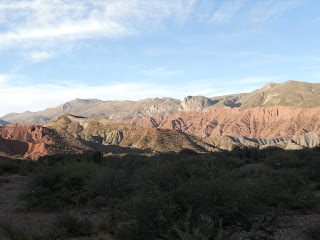
Tupiza is a small, dusty town in red rock cactus country. It´s a bit lower in altitude than the border towns, but you can still notice a shortness of breath in the thin air. On one of our days there I spent a lovely afternoon out in the surrounding countryside on horseback. (As some of you already know, Stu is allergic to horses and therefore couldn´t join me. Plus I had to quarrantine everything I wore as soon as I got back!) My horse was called Pajaro (meaning 'bird'), and he was gorgeous and so well-behaved. By the end of the afternoon I was even confident enough to do a bit of galloping!

Riding through the red rocky landscape:

Tupiza was great for a couple of days relaxation, and we also arranged our trip from there through the national parks of southwest Bolivia, including the famous Salar de Uyuni (salt flats). I´ll leave it to Stu to tell you how that went...

Thursday, 31 March 2011

Biking in Bariloche

So, the bus trip was really comfy, but I have to share this. There was a hilarious handwritten sign on the door of the loo -

In case this is tricky to read, it says, 'Please batrooms only to pi, dont poop on it.' Hah-de-hah ha hah!

Anyway, we arrived in Bariloche in the evening, checked into our hostel, and went to an Irish pub for a disappointing meal and overpriced beer. But the rest of Bariloche was certainly not disappointing - like Pucon, it has a Swiss feel, and is surrounded by gorgeous mountains and lakes. The view from our dorm room was incredible. The town itself is full of Swiss-style wood and stone buildings, many of which are chocolaterias.

While we stayed there we did a great bike ride called the 'Circuito Chico', which is about 20km and very hilly indeed! We took our time over it, stopping at viewpoints and taking a detour on a walk through a forest for a picnic lunch by the 'Lago Escondido' [hidden lake], and it was a great day out. It was pretty tough - on steep hills I got off the bike and walked it up the slope! At the bike hire place we met three lovely people - Emma, Emily and Daniel - who we saw a lot on the ride. On the last stretch of the circuit, we all met up and stopped at a microbrewery to try some local beers. Yum!

Bikes and lakes -


Having a celebratory drink with Emma, Emily and Daniel at the end of the circuit -


That evening our hostel hosted an asado, which is an Argentinian BBQ on a huge grill, with loads of different meats and some yummy grilled veggies for me! Here is the enormous grill -

Just the ticket after a hard day's cycling.

The next day we climbed nearby Cerro Campanario. Lots of people take the ski lift up to the top, but we walked it! The view from the top is one of the best in the world [according to National Geographic] - you can see the whole 'Seven Lakes' district and mountains on the horizon. Absolutely breathtaking -


We met lots of nice people at our hostel, and on our last night we all went out on the town to see a band play at a club. I couldn't catch many of the lyrics, but they were pretty good! The next day we had a plenty of time to recover on our 20-hour bus journey to Buenos Aires. Yes, 20 hours. Actually, it was far comfier than a plane ride - big reclining seats, nice meals and films to watch. I even got a veggie meal! Which brings us to our current location - Buenos Aires. I love BA so far, and we've settled here for the next few weeks while we do some serious Spanish classes. More updates to come soon...

Friday, 25 March 2011

Volcano time!

Well, we got as far south as the northern end of Patagonia - the Lakes District. It is absolutely gorgeous, cold and mountainous, and it reminded us of a European Alpine region. One major difference about Pucón, though, is that it is overlooked by an active volcano which is constantly smoking! Here is the view of Volcán Villarica from outside our hostel:


Naturally, we decided that the thing to do was to climb to the top of this sulphurous mountain, so we did! It was an early start (6am), and we met our guide and got our gear together for the hike. The volcano is covered with snow, so we needed actual snow mountaineering gear and layers of windproof clothing. There were about 12 of us in our group, and four really lovely guides who made the whole day fantastic. We got a ski-lift up the first bit of the hill (it cuts out a boring hour of walking over gravel), and then started zig-zagging up the steep slope. The trek was reasonably tough, but we stopped regularly to catch our breath so it wasn´t too hard. We got to the snow line pretty quickly, and even near the beggining the views were incredible!

Here´s Stu at our first rest stop, with the Lake District stretching out behind:

The view up towards the volcano. It was really windy all along this snowy ridge - I was genuinely worried I was going to be blown sideways down the slope on several occasions!:

More volcano views:

As we progressed, the slope got steeper and snowier, and we had to go slowly to keep our footing. We had ice picks to steady ourselves and to dig into the snow if we slipped (the blustery wind and ice nearly blew me over a few times, but no one actually tumbled down)! After four hours of uphill shuffling, we reached the summit. The hot, smoking crater belches burning, sulphurous smoke that gets in your eyes and throat and makes you cough! It smells like eggs and burning. We couldn´t see any lava; even when I peered as far as I could down into the crater, the smoke obscured any sight of the magma. Nevertheless, we felt an awesome sense of achievement to have got to the top of a real, active volcano.

At the summit, with the smoking crater behind us:

The view from the top, with more mountains in the distance:


After a break for lunch out of the way of the smelly volcano smoke, we headed back down to earth. This is where it got really fun, because the quickest way down is to slide down the snowy mountain-side on your bum! We had plastic trays to sit on to make us go faster, and used our ice picks to control our speed and stop. It was brilliant fun, and as you can imagine it was much faster on the way down!

Here we are, nearly at the bottom of the mountain:

Back at our hostel, the whole group had a few beers and relaxed after an exhausting day. We were in a hostel called The Tree House, and here I am having a nice sit down in a hammock under the tree house itself:

Being a volcanic area, Pucón also boasts some nearby hot springs, and what better way to rest our weary muscles after a day´s trekking than to sit in a massive natural hot tub? So a group of us headed out and spent the evening in lovely hot rock pools with a glass of Chilean red wine.

We spent one more day pottering about Pucón, and then spent an entire day on buses getting to Bariloche, which is just over the border in Argentina. The border crossing was a bit tedious, but actually pretty straightforward, and the buses here are really comfy. I will update you all on our days in Bariloche as soon as I can find a computer that will let me upload more photos...

Thursday, 7 October 2010

Udaipur

As I mentioned briefly in my last post, we’re in Udaipur now and it’s probably my favourite place in India so far! But I’ve got to get us here from Bundi first, so hang on a second…

We checked out of the Lake View hotel in Bundi at about 9:30am on the 5th, with over twelve hours to kill until we caught our sleeper bus to Udaipur. We went down to the lake to read and sip some of Tony the Cook’s chai (spiced tea), which is still maybe the best we’ve had! There we met Londoners Toby and Max, who had just moved into the room we’d vacated. Guys, thanks for your help in killing those twelve hours, they whizzed by!

So anyway we caught our ‘luxury’ sleeper bus just after 10:30pm. These private sleeper buses rule! You get a berth (double in our case) with a sliding glass door and curtain for privacy, then you crawl in with your luggage and go to sleep! I woke up once or twice during the bumpy, eight-hour journey, but I was pleasantly surprised by how quickly it went and how comfortable it was.

As I write this, it’s the afternoon of our second day in Udaipur. We’re staying at the Panorama and we love it! Our room is a very reasonable R300 a night; and the hotel has a rooftop restaurant with great views of Udaipur’s lake. They also have two pet tortoises here who hang out near our room (one adult, one baby). The grown-up one is called Dollar and she’s over 45 years old, while her baby, Euro, is about a year old. Dollar likes me a lot because I keep feeding her leaves.

Udaipur features heavily in the Bond-film Octopussy and consequently dozens of hotels and cafes in the town show the movie EVERY NIGHT. Brilliant. We watched it last night whilst I enjoyed my first meat curry in India (Butter Chicken, it was delicious AND I wasn’t ill: yay!). We also put away a massive bottle of Kingfisher beer each. And why not?!

Before that we spent the afternoon in Udaipur, visiting the Bagore Ki Haveli, home to an amazing collection of Rajasthani puppets and a museum. We also saw the Jagdish temple, which is beautiful. Ania bought a small picture of an elephant, painted by hand on silk, from an artists’ school. In Rajasthan the elephant signifies luck and the city of Jaipur; the horse represents power and Udaipur; while the camel stands for love and Jaisalmer. So we have luck, but no love or power. Which sums up our experiences in India’s hotels! Ha!

Today we visited Udaipur’s palace, which you can see from our hotel. We are right on the waterfront here, but as recently as July the lake was completely dry. One guide told us people were playing cricket on the bed of the lake! The water is now sixteen feet deep in places!

Tonight we’re going back to the Bagore Ki Haveli to watch those Rajasthani puppets in action. There’s a live show which also features traditional dancing. Tomorrow is our last full day here as we’ve booked our bus on to Mount Abu for the 9th.

I’m enjoying India much more in the quieter places than I was in the crazy city of Delhi and I’m getting into the swing of it: booking our hotels by phone (difficult with the language barrier), haggling with shop owners and rickshaw drivers and returning friendly greetings in the street in my broken and very limited Hindi.

All in all, we’re having masses of fun. Udaipur is making that especially easy! Tomorrow, maybe a boat trip and a film starring Sir Roger Moore. I just can’t decide which one, though…

And now for the photos!

The view over the lake from the Haveli. Our hotel is out of shot, but on the side of the land you can see. The floating island on the left (in front of the hills) features in Octopussy. It's where Bond embarrasses baddie Kamal Khan in a game of Backgammon!:


One of the many impressive rooms in Udaipur Palace:


The outside of the Jagdish Temple:


The puppet room inside the Bagore Ki Haveli. Somehow less scary because there's lots of them!:


Me with my new pal, Dollar!:

Friday, 1 October 2010

Bharatpur, Ranthambhore and Bundi

Since we last wrote we've met a lot more travellers and from all over the world. During our time at Mrs Singh's in Bharatpur, we met a couple of couples, one American/Dutch and one Columbian who were very nice; a fellow Englishman called James who we spent
a few happy hours chatting to at our hotel; and a German couple who we shared our train seats with when it was rammed going from Bharatpur to Ranthambhore. It's really nice to meet fellow travellers and everyone seems to identify with one another! It's a bit like Freshers' Week at uni, you bond quickly because of the shared experience.

We spent a couple of hours in Bharatpur itself last week and it didn't really blow either of us away, I wouldn't recommend it. Deeg on the other hand is great! It's about one hour away from Bharatpur and well worth the journey for the palace alone, which is relatively modern and was used by the Maharajas up until the 1950s. There were fountains everywhere, only used two days each year because of water shortages; and a lake on either side of the palace, which runs underneath to keep it cool. We went inside the building itself with a guide and saw the main room, used for dining and lounging. We also saw the Maharaja's bedroom which as you would expect was grand. On the ceiling of the main room they have enormous fans, which are operated from outside (so the poor servants wouldn't even feel the benefit of the cool air). They also had a stuffed female tiger in a glass box, complete with scary face (why?); and two stuffed elephant feet, one designed for use as an ashtray and one as a perfume holder. Isn't that how we all want to be remembered?!

I must make some room now to say how much we enjoyed our stay in Bharatpur at the Falcon Hotel, near Keoladeo Ghana National Park. Mrs Singh and her daughter Tina were really welcoming and the hotel was super-comfortable. We spent several lovely evenings chatting to them and ate the best food we've had in India, freshly prepared in their own kitchen. A new discovery of mine is Malai Kofta, if you can find it back home, get it!

From Bharatpur we moved on to Ranthambhore National Park, home to tigers! Sadly we didn't see any, though. The village nearby is completely geared to safari-goers and closes for three months of the year. We arrived on the 30th September, ready for the first day on the 1st October and the town had a distinct feel of not being ready yet! Painters, builders and cleaners were working hard everywhere to get things ready; and several items on our restaurant menu were available yet, though we did eat well. So no tigers, but we did see lots of monkeys, peacocks, parakeets and two kinds of deer (sambar and spotted) in the beautiful surroundings of the Park. The nearest we came was a reasonably fresh tiger print on the track, which you can see below. It was exciting just to know they were nearby! We were amongst the first to try tiger spotting this season, starting our day at 6am!

At 2pm yesterday we got on a bus at nearby Sawai Madhopur to come to Bundi, where we are now. Guidebook says the bus journey is: 3.5 hours. Reality: 5 hours, 45 minutes. We didn't find this out until about 3 and a half hours in and this was our lowest point of the trip so far. It was crowded, hot and noisy; and Ania and I have now agreed on no bus journeys over an hour long! But we survived (just) and last night arrived in Bundi in the dark at about 8pm. We are staying in the gorgeous Lake View hotel, set in the Meghwahanji Haveli. Havelis are extravagantly decorated Rajasthani houses. There's lots of nooks and crannies in ours and a staircase to a flat roof where we have a great view. The building is 200 years old and is a little shabby, but we love it! The area is very 'buggy', I had to brush a few off our bed and kill dozens of ants in our room, but that one negative aside it's perfect.

Our photos for this post:

Us two, pictured with Mrs Singh and Tina (yes we are using forced perspective here, I'm not really a giant):


A couple of shots of Deeg Palace:


Me being a Maharaja with our guide paying his respects (!), also at Deeg:


The Ranthambhore tiger footprint, those elusive bastards:


Two more shots from Ranthambhore, inside the Park:

Ania reading inside our room at the Haveli in Bundi:


The view from the roof above!: