WHERE ON EARTH HAVE YOU BEEN?!

Showing posts with label music and dance. Show all posts

Sunday, 17 July 2011

Taganga: A Slice of Caribbean Life in Colombia

After our three days in Cartagena Ania and I decided to move on to Taganga, a small fishing village next to the city of Santa Marta. After hopping into a minibus full of tourists, four hours later we arrived at Casa de Felipe, a hostel that had been recommended to us by several travellers and guidebooks. It hasn't disappointed and has turned out to be one of our favourite hostels of the whole trip, right up there with Travellers' Oasis in Cairns, Australia. We arrived on 5th July, and with two days to go to my birthday, decided to splash out on a slightly more expensive room with a TV, its own balcony complete with hammock and a sea view!

Here's Ania repairing her sunglasses with her sewing kit (yes, her sunglasses!) on our beautiful balcony:

For me, Taganga is the place where I truly started to enjoy Colombia. Casa de Felipe is fantastic, a big hostel that somehow manages to feel private and sociable at the same time. There's also an amazing restaurant run by Patrick the Dutch chef. His fillet mignon steak with blue cheese sauce is incredible. There's also great veggie soups and wraps that Ania's been enjoying. We've eaten in the restaurant several times now and as well as the great food and atmosphere, we're usually joined by the hostel's resident kittens who are tiny and so cute! On our first night we met Mel and Steph, two lovely Aussie girls from Melbourne. Here's Mel playing with one of the kittens at our dinner table (after we'd eaten, obviously!):


Colombia has some of the cheapest scuba diving in the world, so on 6th July we set off with a local company called Aquantis for two boat dives. It was unbelievable value! About £40 each for two dives, a basic lunch and photos taken by the guide underwater included in the price! The staff all speak great English and are very helpful and friendly too. The diving was good despite some poor visibility in places. But the amount of wildlife we saw more than made up for that: a sea snake, lion fish, porcupine fish, moray eels (in two different colours) and a lot of squid. Ania saw some seahorses on the first dive after I'd surfaced (I am an official air guzzler underwater). We also had a really nice group of six: us, plus two other couples from the UK and Holland:

L-R that's Nicky, James, me, Ania, Sonna and Rob.

We're ok! Us two underwater:

Some of the aforementioned amazing wildlife: a big lobster we found hiding under a rock...

...and a seahorse:

The next day was my 27th birthday! We saw it in on the night of the 6th. Hanging out on the roof terrace of Felipe's we met an American guy called Dave and his brother Joe. Dave thought I looked familiar and it turned out we'd met him almost four months ago in Pucón in Chile! It was a nice surprise to link back up with someone we'd hung out with before and the guys raised a glass to me as the clock ticked over to midnight on the 7th. The next day began my birthday proper. Thanks again for all the messages and emails on the day, it was so touching to hear from everyone. I certainly haven't had many birthdays abroad, so to have one in South America was really special! On the actual day we didn't do much, aside from some serious relaxing! Ania woke me up with a pancake breakfast in bed from the hostel's restaurant (ain't she sweet?!), I Skyped with my mum, dad and sister and we ate dinner with Mel and Steph.

In the evening we took a walk down to the beach and found a small percussion band playing with the beautiful sunset behind them:


Then we bought arepas from this street vendor. Arepas are cornmeal patties. This guy barbecues his and then stuffs them with guacomole, salsa, cheese and chicken. Yum!

We ate our snacks on the beach and continued to watch the sunset. Ania took this photo, I'd say it's one of the most beautiful from our entire trip:

The following day Ania, myself and Mel headed to nearby Tayrona National Park. Poor Steph was ill, having been taken to hospital and put on a drip just days before. The three of us caught a bus for an hour and a half to the entrance to Tayrona, paid our entrance fee and then set off on a three-hour walk to a beach camp site where we planned to stay the night. We started off by taking the wrong path for the trek, the one meant for horses rather than people!

Mel and Ania at the very start of our walk:

Some leaf-cutter ants! These guys were everywhere and busy, busy, busy. I suspect that somewhere they are building one MASSIVE leaf. But to what purpose?

Our horse track was churned up into a kind of swamp in places (easy with hoofs, difficult without) and I was only wearing flip flops, having not anticipated a tough trek! Very soon Ania and I had gone barefoot to avoid losing our footwear and we were thigh-deep in mud, while Mel had an easier time of it in her trainers!

My new pair of mud-boots. Just dip and let them dry!

Towards the end of the toughest section my left leg went all the way into the mud and I stacked it, ending up sitting down in the mud! I was not best pleased at the time but after a quick wash in the sea I saw the funny side. I believe Mel has an embarrassing photo but I don't have it for the blog. What a shame!

After some easier walking over sandy beaches we reached Cabo de San Juan, where we rented hammocks for 20,000 pesos (about £7) and met up with Mel's friends from home Jim and Chris, plus their friend Tyra from London. By this point it was afternoon so we spent as much time as possible relaxing on Cabo's beautiful beach and cooling off in the rough yet refreshing surf.

Ania relaxing as the light fades on Cabo beach:


Later we climbed the rocks you can see in the distance in the photo above and enjoyed the views, before returning to our camp. Here's our footprints leading back from our mini-adventure:

That evening our little group was joined by Owen from New Zealand and we all had a poor and overpriced dinner, plus some beers, before breaking out our own bottles of rum and ginger ale, which we drank from our old beer cans for lack of cups! We rinsed them out first, what do you think we are, animals?!

After a surprisingly good sleep in our hammocks we woke up, or rather were woken up by some obnoxious tourists, at 7am. It was actually quite nice to be up for a swim before breakfast and to enjoy some beach time before the insanely hot high temperatures in the middle of the day. At one point Ania and I climbed up to a sort of tower they have at Cabo beach. The building has private cabanas and a floor below with more hammocks (the demand is high, but Mel managed to get one for her second day). We checked out the views from the balconies and climbed on some more rocks, as you can see in the photos below:

At midday Ania and I waved goodbye to the others and headed to La Piscina, a different beach on the walk back with calmer waves. There we met James and Nicky again, the couple we'd scuba dived with days before. Ania and I took the right path back to the park entrance this time, which was far easier although it definitely had muddy points! We got the bus back to Taganga and enjoyed a good shower and a proper bed at Casa de Felipe.

Thursday, 23 June 2011

Goodbye to Lima...and on to the Incan capital!

Hello everyone! We're now in the ancient Incan capital city of Cusco, in the Andes, and it's beautiful here. But before I tell you all about it, I still need to fill you in on our final days in Lima at the Karikuy project. In particular, we paid a visit during our last weekend to the San Francisco Monastery and catacombs, right in the centre of Lima. It was built in the 1600s, and the first thing you notice about it is how ornate it is. There are carvings and paintings covering every surface, including one huge painting of a Peruvian version of the Last Supper scene, in which the disciples are dining on Peruvian dishes such as 'cuy' (guinea pig) and spicy rocoto peppers. My favourite room of the monastery has to be the famous library, which is lined with dark wooden shelves and spiral staircases leading up to second-level walkways with thousands of books dating back to the 1400s. Here is the outside of the monastery:

But the visit got really exciting with a trip underground into the somewhat grisly catacombs. These crypts contain the remains of over 25,000 burials (although this is an estimation since it has not been completely excavated). The catacombs were used up until the early 19th century, when their use was banned in an effort to stop the spread of epidemics. The catacombs have several sections: first the bodies were stacked on top of one another in one area and covered in lime to reduce odour and disease. Aftre they had decomposed, the bones were then moved to an ossuary, where they were stacked more compactly (I don't envy the people who had that job). In these catacombs, the bones were (rather creepily) arranged in concentric circles in sunken wells which served as ossuaries, and some skulls were hung from the walls. There was a remarkable equality in all this: people from all walks of life were buried here, rich and poor, from servants to monks, all piled in together. Walking through the dark catacombs with their low ceilings, there were so many skulls and bones everywhere that it was hard to take in that these were all people from centuries ago.

An ossuary well full of remains. We were told that the bones in this one were ten metres deep:

The centre of Lima is full of beautiful colonial architecture, which is a nice antidote to the sprawling grey of most of the city. Here is the parliament building:

Another view of the main square:

The above picture also gives a good indication of the weather most days in Lima. It is winter here at the moment, but also Lima has a sort of microclimate of its own, so that it is often overcast and grey here when elsewhere in Peru the sun is shining!

Another outing during our last weekend in Lima was for ceviche, which is a famous part of Peruvian cusine. Basically, it's raw fish marinated in lime juice and spices. (Being veggie and also ill at the time, I didn't have any, but Stu assures me it was delicious.) Here is the huge platter the guys shared, with fish, squid, langoustines, oysters and crab, decorated with a celebratory umbrella:

(One thing I won't miss about living in Lima is how hard it is to get anything vegetarian. In the more touristy places in Peru finding veggie food isn't a problem, but we were living in a non-touristy area where meat-free meals were virtually unheard of.)

During our last few days in Lima it was Julio's aunt's 79th birthday. She lives in the flat below us, and all the family came round for a little party. We were lucky enough to be included, and it was lovely to see how important family is in Peruvian life. Most of Julio's family lives within five minutes' walk, and the house was full of uncles, aunts, and cousins. Everyone was fed and there was enough cake to feed everyone twice over!

On our last night in Lima, Julio and the other volunteers surprised Stu and me with a cake of our own:

It says 'Feliz Viaje', which means 'Happy travels'. We really weren't expecting anything and I actually felt a bit tearful about saying goodbye to our friends here.

Here we are with the delicious cake (Kate, me, Julio, Stu and Naysi, Julio's girlfriend):

After a quick internal flight we arrived in Cusco, which was the capital of the Inca empire and is today the jumping-off point for trips to Machu Picchu and the Sacred Valley of the Incas. But Cusco is much more than just a gateway town; although it is very touristy, it is a beautiful city in its own right. There are beautiful colonial plazas and buildings, and many of the colonial buildings were built by the invading Spanish colonisers on the remains of the Inca buildings they demolished, so the sturdy Inca stone walls are still very clear. It´s very hilly, and our hostel is up a steep cobbled alleyway that gets you a bit out of breath to walk up in the thin air (Cusco is at about 3400m altitude).

Our street in Cusco. You can see Cusco´s rainbow flag here (not to be confused with the Pride rainbow flag):

Murals in Cusco´s streets:


We chose a great time of year to visit Cusco, since June is a month of celebrations. The week we arrived there was the Corpus Christi Catholic festival for a couple of days, followed on the 25th June by the Inca winter solstice festival, Inti Raymi. And the week after we leave marks 100 years since Machu Picchu was ´discovered´ by American explorer Hiram Bingham and made known to the wider world. So we arrived straight into a week of parades, brass bands in the streets, decorations, dancing and all manner of festivities. (Actually, as I write this now a parade is going past this internet cafe with loads of folks in costume playing drums and panpipes.) Our hostel has a lovely roof terrace with a great view of the main Plaza, but we also headed down into the mayhem to have a closer look.

The Plaza de Armas during Corpus Christi, with one of many statues of saints being carried in the foreground, and the cathedral in the background:


On the day of Inti Raymi, we walked up the steep hill behind our hostel to the Incan archeological complex of Sacsayhuaman (which I´m ashamed to say still makes us giggle like teenagers because it is pronounced ´sexywoman´). This is where the main part of the festival takes place in a big square. The festival is a recreation of the traditional Incan winter solstice ceremony, in which the sun god is worshipped. There are a few changes: traditionally a llama is sacrificed and the high priest holds aloft its bloody heart in honour of Pachamama (Mother Earth) - these days this is acted out but the llama isn´t harmed, thank goodness! You can buy tickets for a seat with a close view of the proceedings, but we opted to do as the locals do and sit on the hillside overlooking the complex for free, albeit faraway view. It was a swelteringly sunny day, and we got there a good few hours before it started to bag a spot to sit. As the day wore on it got more and more crowded, as entire families squeezed into any free gaps on the steep rocky hillside. Vendors climbed about selling drinks, hats and snacks. It great to get a taste of this big day out, but it was far from comfy! Finally the festivities started, and dancers in traditional Andean/Incan dress paraded in formation across the square in time to music which blared out out over the speakers.

The procession comes down through the Sacsayhuaman ruins into the main square. In the square was a stone plinth, on which the man portraying the Sapa Inca (which is a great honour) overseas the proceedings:

Our seat on the crowded hillside, looking across to a second crowded hillside:

A taste of the music and dance. The costumes were great, and several of the spectators were in traditional Andean dress too:


Finally Stu and I got so uncomfortably overheated and squished in the crowd that we decided to make a break for the exit. This was actually quite difficult, as we had to climb over everyone else to get out! But we managed it, and headed back down the hill to get a well-deserved ice cream from a street vendor. (The were loads of markets and snack vendors on the walk between the town centre and Sacsayhuaman, including several stalls selling charred-looking guinea pigs on sticks - yum.)

We´ve really enjoyed Cusco, which is a great place to hang out, eat great food, and buy souvenirs. But the real reason we came here was, you guessed it, Machu Picchu. And not just Machu Picchu itself, but the four-day trek along the Inca Trail to get there. But that story is for another post...

Wednesday, 25 May 2011

I'm the Capital of Bolivia! No I Am! No I Am! You Liar! I Am!

I should probably start by explaining that title. Bolivia is a country with a rare situation when it comes to its capital: it has two! Sucre is the constitutional capital, while La Paz is the administrative capital. I get the feeling there's something of a rivalry over their claims to the title, but it seems to be pretty good-natured. Ania and I thought we'd group these two together in a post, especially as we visited them in quick succession.

We spent five days in Sucre at a strange hostel where we at least had a very nice private room. We took some time to relax after the high altitude and sometimes tough conditions we experienced in the Salar de Uyuni and Potosí. Sucre is a beautiful city. It's small and completely walkable, with very Mediterranean-style buildings: white-washed structures with terracotta roofs. It definitely reminded us of Malta in places!

Any regular readers of this blog will know that Ania and I class ourselves as reasonably foody people and are in some ways 'eating our way around the world'! Sucre was one of those wonderful havens for us where we could rest, read our books, walk around the town and... eat! We found several good restaurants within the first couple of days and then revisited our favourites in the second half of our visit. The ones worth mentioning are Locot's, where the menu includes burritos and Indian curry, with veggie versions of both. Very impressive! There was Cafe Monterosso, a hidden gem of a restaurant run from a family's converted living room, where we ate great pasta, baked aubergine and panna cotta. Florin was great too, where on our last morning I got the Bolivian/French influenced version of a Full English breakfast, complete with baked beans (they were also showing Tottenham Hotspur beating Liverpool in the penultimate game of the Premier League, which always helps the food go down!). Finally, there is a little cafe/restaurant (the name of which I don't recall) in the Recoleta area. We ate here twice. It's chief features are excellent fresh fruit juices, tasty pastas and salads, an annoying food-scavenging cat which scratched Ania (!) and fantastic views of the city:

Sucre has a thing for dinosaurs and we didn't really understand why at the time. As I've said, we were busy taking a well-earned breather! A quick Google search tells me that the town is home to the world's largest collection of dinosaur footprints! They're about 60 million years old and were discovered by workers from a cement factory in 1994. Interesting, huh?! During our time in Sucre, we did see that some tour companies offered dino-themed trips, but we didn't know any of the history. Shame on us! Bearing our ignorance in mind, you can imagine our bafflement and amusement when we happened upon statues and other figures, including this delightfully tasteful public telephone outside Sucre's beautiful cemetery:

An interior shot of the aforementioned cemetery. Much like the one we visited in Buenos Aires, its like a beautiful town with the graves and memorials above ground. Below you can see small memorials with glass doors in gold frames. Relatives put flowers and tokens inside. We even saw one with a miniature bottle of beer!

Our next stop was La Paz, which we reached by overnight bus. I certainly won't miss these long journeys, and this wasn't a particularly good one! Ten hours, admittedly helped by the inclusion of our first fully 'cama' (bed) seats, that reclined to a proper horizontal position! The ride was not improved however by the very noisy, very crap movie playing. Although in retrospect I do appreciate the comedy value of The Gods Must Be Crazy II! We arrived in La Paz at about 6am and stayed at the beautiful Cruz de Los Andes hostel. They were even nice enough to let us into our room at such an early hour to have a quick nap! The entire hostel is painted floor to ceiling with beautiful murals of La Paz. Here's one from our room:

Our two nights in La Paz were spent with more relaxation, food and wandering. One of the best sights in the city - which incidentally is bigger, noisier, more crowded and far less picturesque than Sucre - is the Witches' Market. We enjoyed browsing the stalls selling llama-wool products, jewellery, the usual tourist crap and bizzarely, dried llama fetuses! Mmmm! Needless to say we did not buy one. We read in one guidebook or leaflet that they are considered good luck and Bolivians buy them to bury under the porch of a new house to bring good fortune to the residents. If you look closely at the picture below, you can see one:

A shot of a mini bread market in La Paz:

La Paz's restaurants are also worth a mention. On the first day we found a British-owned curry house called 'The Star of India'. It even has a British-style name! We were pleased to find they did their own version of the Bolivian and Peruvian-style almuerzo (the word literally means lunch, but in this context is a set meal usually consisting of soup, a main and dessert for a fixed price). Frustratingly, the veggie options weren't amazing and Ania was left disappointed. I really enjoyed mine though! And they did great lassis! We also enjoyed Marrakesh, a Moroccan place with a very friendly husband and wife team who served us fantastic couscous and refreshing mint tea!

Another highlight from our limited time in La Paz was our visit to the 'Museo de Instrumentos Musicales de Bolivia'. That's the Museum of Bolivian Musical Instruments, in case you couldn't work it out! This was really interesting, with pipes, piano-style instruments, guitars and charangos, drums, glockenspeils, xylophones and lots more! Some of the pieces were pre-Incan and there was even a mummy-type figure in a glass case in the early section, which had been found with different musical instruments by the look of it. Many of the pieces were made from animals, for example, these two guitars made with tortoise shell and armadillo:

There was also opportunity to play several of the instruments. Here's Ania playing a kind of pump-powered organ. It was really good fun!


So that was my Tale of Two Capitals. We both really enjoyed Bolivia; and Sucre and La Paz both embodied different elements of the things we so loved about this country, in their own unique ways! The people, the food, the landscape, the buildings and the culture: we highly recommend it all! I sit writing this in Peru (we're playing catch-up a bit on our blog); but as far as chronology, and you, dear reader, are concerned, we still have one more stop in Bolivia to go before we move into neighbouring Peru. Oh, and what a stop it was!

Friday, 29 April 2011

´Hehehe... Look at this country: You are gay!´

Unfortunately Homer Simpson was wrong and it is, of course, pronounced 'Uruguay'! After bidding farewell to Buenos Aires on 16th April Ania and I caught the 'Buquebus' (pictured below): a ferry that takes you across the Rio de la Plata (the River of Silver), the huge estuary that runs between Argentina and Uruguay. You can make the crossing in one hour or in three. We opted for the slightly longer one and it was really smooth sailing. The immigration process was excellent too, with the Argentinian and Uruguayan officials checking passports as you checked in for the boat in BA.

On board we were treated to some live music. It was like a ferry crossing meets a cruise ship! A man and a woman were singing, sometimes solo, sometimes a duet. The guy was good with a deep operatic voice. The woman was pretty bad! She fancied herself as a bit of a Mariah Carey and was pretty flat!

In a few hours we arrived at the beautiful Uruguayan town of Colonia del Sacramento. Lots of people come here on a day trip from Buenos Aires, but we spent two nights in Colonia in a very basic hostel. We didn't mind as the bed was comfy and Colonia is so photogenic! I took this photo on our first evening after we'd had a nice meal on the waterfront. Way off towards that beautiful sunset is Buenos Aires! It's still difficult to believe that what you´re looking at is not the sea but a river!

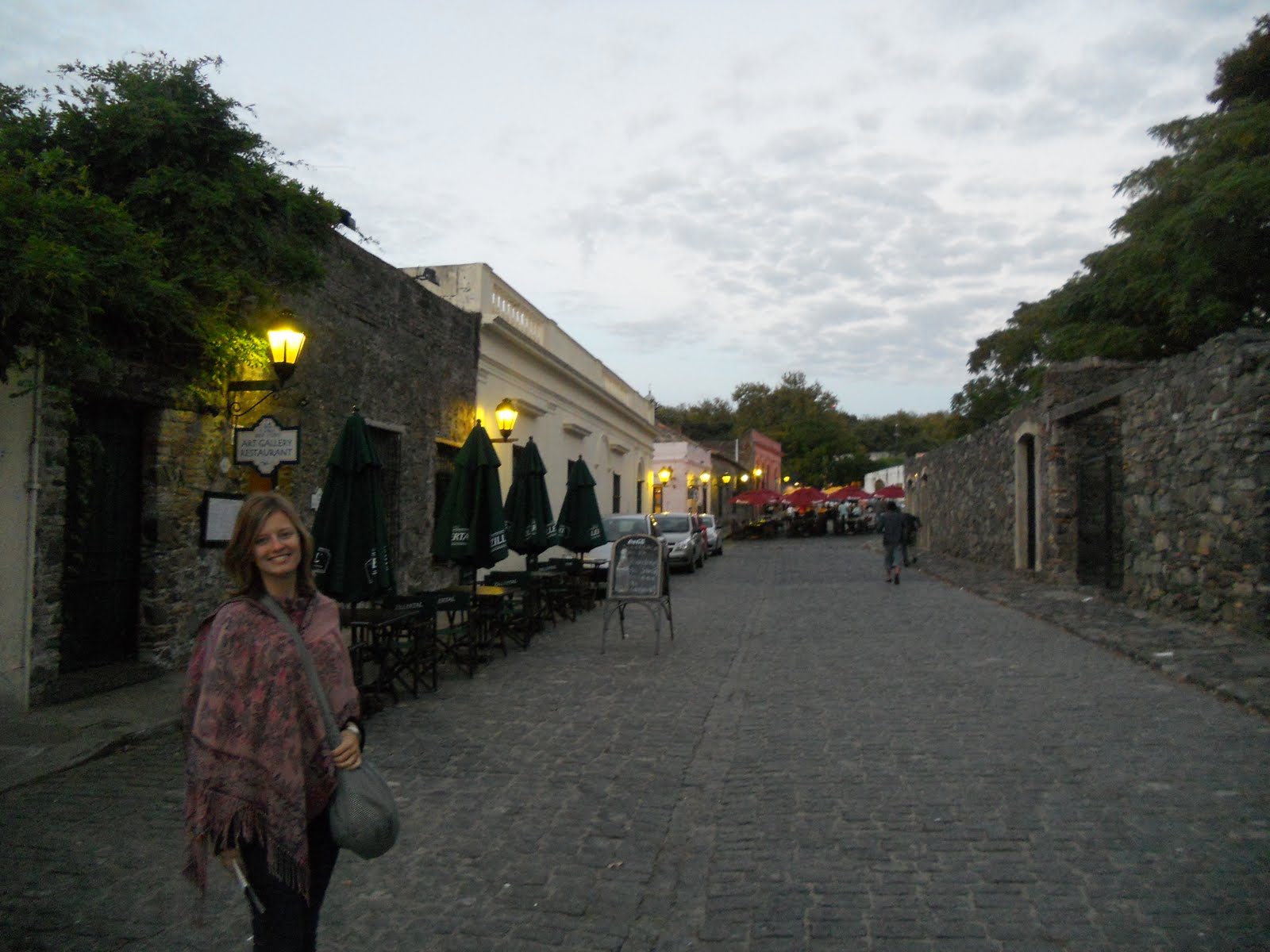
In Colonia we did a lot of hanging out and enjoying the sights. The town has these really pretty lanterns that are switched on at night. Combined with the cobbled streets, it´s a wonderful place to just walk around and take photos!

Colonia´s lighthouse, with the ruins of an old convent and an artesan craft fair on the right:

Me standing by some ruins:

Of course we did the foody thing in Colonia too! The town is known for its cheeses, so one evening we had some very nice local cheese and wine in a restaurant. We also bought some 'helado artesanal' (home-made ice cream) and sat next to the aforementioned ruins, looking across the Rio de la Plata one afternoon.

Next it was on to Montevideo, Uruguay's capital! We caught a two-hour bus from Colonia and arrived in the Pocitos district, where we stayed for three nights at the Pocitos Hostel. This place deserves a special mention, mainly thanks to one of the owners, Nacho, who was so helpful, friendly and thoughtful. We slept our first two nights in a dorm and Nacho very kindly offered to put any new guests to the hostel into the other rooms if possible so that we could have some privacy. He also helped us book a hostel at our next stop in Rosario in Argentina when we couldn't find anything because of the busy Easter weekend (more on that later). Nacho, you're a legend! Thanks for such a nice stay! If anyone reading this is going to Pocitos I recommend the hostel. It is a hostel and is 'no frills' and a little shabby in places (could do with more bathrooms!) but it more than makes up for it with a great atmosphere and helpful staff!

While in Montevideo we tried a Uruguayan 'delicacy': a chivito. The name means 'little goat', although there is no hint of goat in this uniquely Uruguayan sandwich. Basically, it's a sandwich with everything in it! Steak, cheese, ham, bacon (yes, ham and bacon!), olives, eggs, salad, sauce, mushrooms, it's got it all. Yes, the photo below looks disgusting, but actually it tasted pretty good! This chivitoria (place that sells chivitos, of course!) was opposite our hostel in Montevideo and they even had a veggie option for Ania. Mmmmm... fattening...

We really enjoyed Montevideo, but I think that was down to the great people in our hostel, both the staff and the other guests, rather than the place itself. The city was ok, but really didn't blow either of us away, especially as we visited it right after spending time in Buenos Aires and Colonia, two very different places that nonetheless have such a unique charm. We did venture into Montevideo's Old Town one afternoon and it was ok, but more on the shabby side of old rather than having Colonia's character!

The gate from the main city to Montevideo´s Old Town. Security is tight beneath the gate, but the wily traveller can just walk around it...

I admit it: Ania is our official map reader! I almost managed to get a shot of her unawares while she navigated us around the Old Town in Montevideo.

We did really like the Pocitos area of the Uruguayan capital. The city centre looks like it could be anywhere really. Pocitos on the other hand is very suburban, leafy and quiet; and it has a pretty nice beach. Here's Ania having a paddle on our first day in Montevideo:

And that was our five days in Uruguay. Not much, but we were both so glad to experience a new place. Uruguay is a really interesting country! A quick check on Wikipedia tells me the population is 3.5 million and I know that they hosted and won the first ever Football World Cup in 1930 (they've won it once more since then, too)! Eat that, fact fans!

I certainly feel that we can't do our usual 'Things We Liked, Things We Didn't Like' thing about Uruguay (we didn't do this for Chile for the same reason after spending just 11 days there), but I can say that we both really liked it. My main impression of the place is how nice the people are. Oh, and they love their 'mate', perhaps even more than the Argentinians! There weren't many places we went where people weren't carrying the obligatory flask of agua caliente and a cup of yerba 'tea'.

From Montevideo we caught a 10-hour bus to Rosario in Argentina. To cut a long story short, it was a nightmare. Nacho warned us that the hostel he'd booked for us might be a bit of a party zone, but when we walked in it was my own personal hell: like someone had attached some bedrooms to a Wetherspoons pub on a Friday night. A subwoofer speaker had been moved up against the wall of the six-person dorm that we were supposed to be able to sleep in! After saying that we did actually want to be able to sleep (shock, shock horror!), we were moved to a quiter place around the corner, but it was an absolute hole, complete with bathrooms with no locks on the doors and one with a massive hole in the door! And they wanted to charge us twice the normal rate because it was Easter. We spent approximately fifteen hours in Rosario, before getting the hell out of there! After a stressful hour spent booking things in the bus station, we set our sights on our next stop, Puerto Iguazu. Only time would tell if the gamble would be worth it...

Tuesday, 19 April 2011

BA Part Deux

We've now left Buenos Aires with heavy hearts after three fantastic weeks living there, and we're back on the road! We enjoyed BA so much, and were getting so much out of our Spanish courses, that we seriously considered staying there a bit longer, but after listing all the places we still want to see we realised we really had to get going if we wanted to see them all.

Living with Susana really made our BA stay something special. She was great fun and always made the time to sit and chat with us in Spanish so that we got lots of practice. She also took us out in her car a few times to show us round some of the suburbs of Buenos Aires. We´ll miss you, Susana!

One weekend we took the train out to Tigre, about an hour north of Buenos Aires. Tigre is a pretty town in the Paraná Delta, and lots of porteños (people from BA) go there on weekends. The town is surrounded by interconnecting streams and rivers, and lots of people are out on boats, canoeing, rowing, or motoring down the street-like waterways. I'm afraid to say we forgot to bring our camera on the trip, so I can´t post photos, but it was a beautiful day. There were lots of market stalls selling artisan furniture, jewellery, food, etc, so lots to see and do. We took a boat trip down the waterways in the afternoon, and we really got a sense of how the waterways were like streets - there were houses along the banks of the rivers and every house had a jetty and a boat to get around. Smaller streams branched off the main rivers like smaller roads, and lots of people were out on their jettys sipping their evening mate and waving as we went past.

We also paid a visit to the Mate Museum in Tigre. As Stu mentioned in his last post, mate is drunk in Argentina and Uruguay with the same regularity and enthusiasm with which us Brits enjoy a nice cup of tea. We always see people out and about in town with their mate cup in hand and a thermos of hot water tucked in the crook of their arm to keep it topped up. Mate is a caffeinated drink brewed from yerba mate (green in colour, quite bitter, sometimes sugar is added). It is drunk from a gourd through a metal straw with a filter on the end to filter out the leaves. The Mate Museum in Tigre had a very large display of mate cups made in hundreds of styles and lots of different materials.

We got back to BA that evening and hopped in the car with Susana to go to a tango class! The class was held in a big, spooky room with echo-ey tango music played loudly out of the shadows. The other people in the class already knew the basics and looked pretty good at tango, and we headed into the fray to give it our best shot. But it was so much harder than it looked! You have to have your feet really close to your partners, which resulted in Stu and I treading all over each other most of the time! You need to be so tuned in to your dance partner´s steps, twist your hips and cross your feet over each other´s a lot. Phew! Needless to say, we stuck with practising the first basic steps while the rest of the class worked on some more complex flourishes. It was in equal parts interesting, embarassing and hilarious, but I´m very glad to have given it a go! Here are some of the more accomplished students in the class - it was very atmospheric:


The Friday just gone was our last day at Spanish school, and we both received our certificates! I can´t speak highly enough of the classes we had at Íbero - the teachers were great and I really learned a lot and got lots of practice. Special thanks to our teachers, Alejandro and Marina!

I will also miss our local lunch spot just down the road from our school. This nameless, veggie, help-yourself buffet place had loads of delicious fresh salads and yummy veggie takes on Argentinian food, like aubergine tortillas and pumpkin empanadas - yum! We went there almost every day...

Being studious types, we got some extra language practice at 'Spanglish', which was an evening event for people wanting to practice Spanish and locals wanting to practice English. It was like a language exchange crossed with speed-dating: you sit at a table with someone fluent in Spanish, and you chat for five minutes in Spanish, five minutes in English, and then move on to the next table to talk to somebody else. All this, and in a pub too! Spanglish nights had the added bonus that we made some new friends in Buenos Aires.

On our last night in BA, we drove to Palermo with Susana. Palermo is a posh area of BA, with lots of shops, cafes and restaurants. It was a really nice to have a wander about the area, chatting and peeking in shops and market stalls. We even saw a very nonchalant stilt walker at one point, who gave the impression that he didn't know why people were looking at him. Here we are with Susana having dinner in Palermo:


I would really like to go back to Buenos Aires one day - it's certainly been one of the highlights of our trip so far.

Sunday, 10 April 2011

BA Life

We have been living in Buenos Aires for just over two weeks now, so we thought it was high-time you got an update! As well as seeing the beautiful city and enjoying all it has to offer, we are here to learn Spanish and are taking classes at Ibero, a school on Uruguay Street here in BA. We are both really enjoying it! I am in the beginner class as my knowledge of Spanish was absolute zero when we arrived; Ania is in the intermediate class, having studied the language up to A-Level.

We asked Ibero to arrange a home-stay for us here in BA, as we wanted to practice the language outside of school. So we are living with the lovely Susana, who has a beautiful apartment with the highest ceilings I've ever seen, in a fashionable and lively area of BA called San Telmo. We have our own room and share the kitchen and bathroom with Susana. It's been so nice to unpack and not live out of a backpack for a bit. Here's the view from our room:

San Telmo really comes alive every Sunday, when it has a busy market with stalls selling everything from jewellery to mate cups (pronounced 'MA-TAY', it's a kind of South American tea that's really popular here and in Uruguay) to antiques to delicious street food. The market takes over a whole cobbled street called Defensa. At one end of the road is the square, the Plaza Derrego, where on our first weekend we stood fascinated while dozens of people danced the tango with a live band at night:

Same market, different day. A shot of Defensa during the day one weekend.

Of course we have done the tourist thing here in BA, but the thing that occupies us the most is studying! We have class 9am - 1pm, Monday to Friday, I mean 'Lunes a Viernes'; and we get lots of 'tareas' (homework!). Thankfully we have a big desk in our room at Susana's. It's times like this I'm glad I'm not staying in a hostel:

Our class sizes vary, but most people do the beginner classes, so Ania's group has been smaller than mine. In my first two weeks we had nine people, so it was slow going at times, but I have learnt a lot. It's really satisfying to be able to talk to people in shops now, or ask for directions. Before we did our classes, we were completely reliant on Ania's Spanish ability, so I'm pleased to be able to contribute now, even if it's only in a small way!

People from BA, or 'porteños' as they are called, live life late! Dinner is at 9 or 10pm and the nightclubs have special deals, letting the early birds in for free before 3am! We haven't been clubbing here actually (we prefer the pubs), but they open until 6 or 7am. I'm getting too old for that! Earlier I mentioned how San Telmo comes alive on a Sunday. Well the setting of the sun or the closing of the market doesn't mean the fun stops there! At dusk people remain on the streets, sharing enormous, litre bottles of beer (ok, I'm dressing it up, it's called 'street drinking'!). Here's me and my friend Jonee from my Spanish class, who interestingly enough is Jonee Duggan!

'But Stu,' I hear you ask, 'You're in Buenos Aires, you're street drinking, what more could you possibly want?!' Well, how about a live percussion band?! Every Sunday there are a few of these groups banging around in the street, but this one is our favourite. They seem to be the biggest and therefore the loudest. If you watch the video below you can see their 'conductor', a crazy character in the middle who controls the tempo and the rhythm with a whistle!


We can see BA's enormous obelisk as we walk to school every morning. Here's Ania standing in front of the landmark.

The unique cemetery in the neighbourhood of Recoleta. We went here last Thursday. All of the tombs or graves are above the ground; and you can see the coffins inside. It was quite spooky! As you can see below, the statues and carvings are extremely ornate and the 'streets' of the cemetery go on for ages!


The grave of Eva Perón. She was the wife of Argentina's President in the 1940s and 50s and Madonna played her in the film Evita.

A scary statue in the cemetery. This reminded me of the Resident Evil computer games series! You can see a cat in the bottom right hand corner. There are loads of cats in the cemetery that appear to be strays. It reinforces the Egyptian idea of cats as the guardians of the underworld. Please don't lock me in here at night!

Tango dancing is hugely popular here and it seems to be going on everywhere. I took the following video one Sunday in San Telmo. We were in the market when it started to rain, so Ania, Jonee and myself took shelter in this cafe. A couple of tango pros were dancing with a great duet playing live music (guitar and some kind of Argentinian squeezebox/accordion thing). It was one of those wonderful, spontaneous moments that you just can't plan:


For once I haven't mentioned food in my blog post, but don't worry, let me rectify this grievous error! Argentinian food generally is ok and we've had to learn that the supermarkets generally are a bit crap. It's more like it used to be in Britain, where you go to town to do your shopping and visit the butcher, the baker, the candlestick-maker, etc. You know, before Tesco bought everything. The food here mainly consists of bread, meat and potatoes with little spice available (which surprised me). They do really like pasta though so Ania has managed to find veggie food, and of course like any other big city, BA does have a variety of restaurants. But if you're eating out here what you really want to go for is the steak. The beef here puts the stuff we have in Europe and the stuff we tried in Oz or NZ to shame! It's simply in a different class! Last week we went out for a meal with some of our classmates, to a restaurant called Desnivel, handily just around the corner from our house in San Telmo. Desnivel is a 'parilla': an indoor barbecue restaurant specialising in steak. I got the Bife de Lomo (tenderloin or filet mignon) with roast potatoes and we had a nice bottle of Argentinian red wine. Honestly one of the best meals I've ever had.