WHERE ON EARTH HAVE YOU BEEN?!

Showing posts with label food. Show all posts

Friday, 5 August 2011

The Last (Blog) Post...

After our epic trek to the Ciudad Perdida, Ania and I headed back to the wonderful Casa de Felipe in Taganga to rest up for a few days. Many of our group were still staying in the hostel and those who weren't turned up most nights to eat the tasty food from Patrick the Dutch chef's kitchen, based at Casa de Felipe! During the last week we went diving once more with Aquantis, doing two boat dives one morning. Once again we loved it! We saw great wildlife including more lion fish and moray eels. The highlight was probably an octopus that we scared a little, resulting in it inking itself and swimming off very fast! Hadn't seen that before! We also enjoyed our dives because it was just the two of us in a group with a very nice dive leader from Australia called Shanna. And once again we got more great photos of us underwater.

Caption competition? Ania and I experience some underwater communication problems!

After a few pleasant days relaxing we said goodbye to Casa de Felipe and took a bus to Palomino, where we'd booked a treat of a resort for the final week of our ten-month trip! Our destination was Tuci's Place, also known by the names Donde Tuci and El Matuy. After a very interesting but actually very enjoyable bus ride, we arrived! We caught a local bus and were amongst only four tourists on board. The bus had a conductor as well as a driver and the vehicle seemed to be operating not only as a bus but also as a courier service. People would load on enormous sacks of onions or cardboard boxes full of produce which the conductor would then deliver at people's homes or restaurants and cafes along the way! They were very friendly too and helped us with our bags. And as for El Matuy, I cannot recommend this place highly enough! We spent seven very happy nights in this wooden, palm-thatched cabin, seconds from the beach:

We were surrounded by palm trees and spent our time cooling off in the sea, eating the delicious food (included in the price - more on that later!) and lazing in our hammocks with our books. Here's the view from our cabin veranda:

A nice view for lunch:

I LOVED the food in Colombia. I couldn't say what the grub is like in other parts of the country as we only spent time on the Caribbean coast. We quickly discovered that lunch is the best meal of the day at El Matuy. That's nothing against what they served for breakfast or dinner, we just really liked the lunch! The picture below is fairly typical fare and makes my mouth water! Smoked fish, coconut rice (made using the copious coconuts hanging everywhere above us), salad with mango, fried plantain and beans for Ania! Delicious!

And to drink? Amazing fruit juices of course! We liked the mora (like a mulberry, a cross between a blackberry and raspberry), the maracuya (passion fruit) and their home-made lemonade. Here's the owner of El Matuy, Ernesto, who would also cut us open a coconut if we wanted something to drink and to snack on:

A happy woman with an enormous coconut:

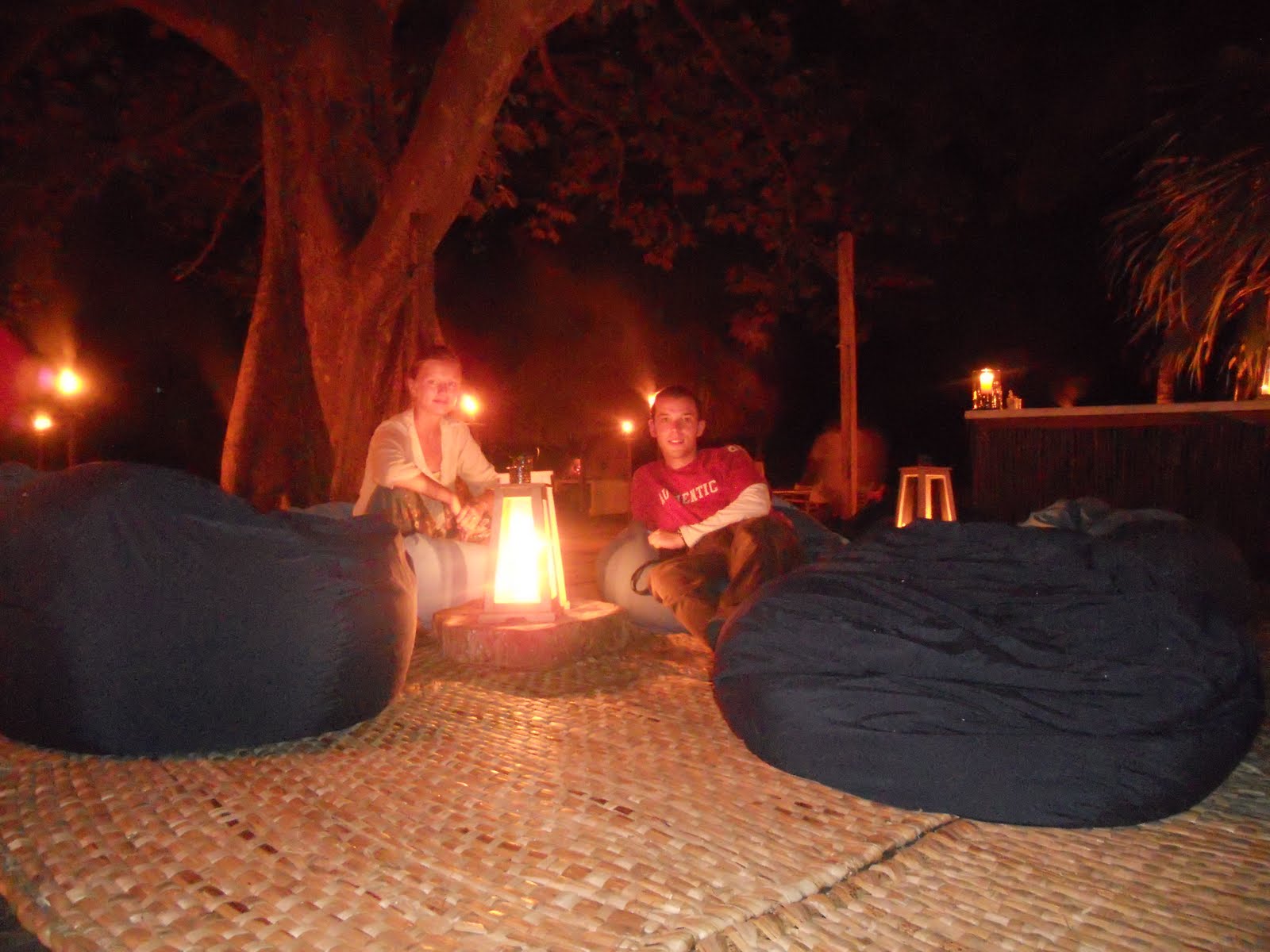
Our evening hangout spot! There's no electricity at the resort, so we'd sit on these beanbags next to the dining area, chatting with our fellow travellers by the light of candle lanterns and oil lamps! Very romantic with the stars above us too!
The beach was great too with some lovely soft sand and we spent a lot of time lying on bean bags on the beach, reading and then jumping in the sea to cool off. There were some pretty rough waves so we enjoyed the challenge of getting past them and then riding them back in to shore. A couple of times we turned right at the beach and walked along the beach, where you can swim in a river that flows into the sea, just in case you fancy a change from salt water. The scenery was beautiful and the area is so secluded that you don't see many people. After so long travelling and roughing it in places, this was bliss!

The one proper 'activity' we did during the week was tubing or black water rafting. We had a go at this in New Zealand but this was far more relaxing! Ania and I set off with a lovely Canadian couple we met called Neil and Moira. First, four 'moto-taxis' turned up (that's a motorbike, you sit on the back!). We collected our tubes, like a big inflatable donut and then got back on our moto-taxis (yes, with the tubes!) and met our guide, a very friendly seventeen year old Colombian boy. After a short but tricky, up-and-down-hills walk we came to the Rio Palomino. We sat in our tubes and gently floated downstream for just under an hour! The water was very shallow in places, I'm talking shin-deep, but it was very enjoyable and the whole thing including our moto-taxis only cost about £10! Well worth it.

We saw some amazing sunsets in Palomino, too. Here's a few shots below. They don't really do it justice, but it does give you an idea!

I started this post by referring to an epic journey, and I'll end it in the same way! On 28th July we set off on what would become a 28-hour journey that would take us from El Matuy in Palomino to Ania's aunt and uncle's house in London! A bus, a taxi, three flights and three delayed pieces of luggage later (never fly with Iberia if you can avoid it. Both of our flights with them were delayed and we arrived in London with only the clothes on our backs and our hand luggage while our backpacks continued the trip in Madrid) we arrived at Heathrow, where Penny and John picked us up! They dropped us off too, so there's a nice symmetry there!

We will follow up with some extra 'bonus posts', but here concludes the diary entries of Ania and Stu's Big Trip. Thanks for reading as always, everyone. Stu over and out.

Sunday, 17 July 2011

Taganga: A Slice of Caribbean Life in Colombia

After our three days in Cartagena Ania and I decided to move on to Taganga, a small fishing village next to the city of Santa Marta. After hopping into a minibus full of tourists, four hours later we arrived at Casa de Felipe, a hostel that had been recommended to us by several travellers and guidebooks. It hasn't disappointed and has turned out to be one of our favourite hostels of the whole trip, right up there with Travellers' Oasis in Cairns, Australia. We arrived on 5th July, and with two days to go to my birthday, decided to splash out on a slightly more expensive room with a TV, its own balcony complete with hammock and a sea view!

Here's Ania repairing her sunglasses with her sewing kit (yes, her sunglasses!) on our beautiful balcony:

For me, Taganga is the place where I truly started to enjoy Colombia. Casa de Felipe is fantastic, a big hostel that somehow manages to feel private and sociable at the same time. There's also an amazing restaurant run by Patrick the Dutch chef. His fillet mignon steak with blue cheese sauce is incredible. There's also great veggie soups and wraps that Ania's been enjoying. We've eaten in the restaurant several times now and as well as the great food and atmosphere, we're usually joined by the hostel's resident kittens who are tiny and so cute! On our first night we met Mel and Steph, two lovely Aussie girls from Melbourne. Here's Mel playing with one of the kittens at our dinner table (after we'd eaten, obviously!):


Colombia has some of the cheapest scuba diving in the world, so on 6th July we set off with a local company called Aquantis for two boat dives. It was unbelievable value! About £40 each for two dives, a basic lunch and photos taken by the guide underwater included in the price! The staff all speak great English and are very helpful and friendly too. The diving was good despite some poor visibility in places. But the amount of wildlife we saw more than made up for that: a sea snake, lion fish, porcupine fish, moray eels (in two different colours) and a lot of squid. Ania saw some seahorses on the first dive after I'd surfaced (I am an official air guzzler underwater). We also had a really nice group of six: us, plus two other couples from the UK and Holland:

L-R that's Nicky, James, me, Ania, Sonna and Rob.

We're ok! Us two underwater:

Some of the aforementioned amazing wildlife: a big lobster we found hiding under a rock...

...and a seahorse:

The next day was my 27th birthday! We saw it in on the night of the 6th. Hanging out on the roof terrace of Felipe's we met an American guy called Dave and his brother Joe. Dave thought I looked familiar and it turned out we'd met him almost four months ago in Pucón in Chile! It was a nice surprise to link back up with someone we'd hung out with before and the guys raised a glass to me as the clock ticked over to midnight on the 7th. The next day began my birthday proper. Thanks again for all the messages and emails on the day, it was so touching to hear from everyone. I certainly haven't had many birthdays abroad, so to have one in South America was really special! On the actual day we didn't do much, aside from some serious relaxing! Ania woke me up with a pancake breakfast in bed from the hostel's restaurant (ain't she sweet?!), I Skyped with my mum, dad and sister and we ate dinner with Mel and Steph.

In the evening we took a walk down to the beach and found a small percussion band playing with the beautiful sunset behind them:


Then we bought arepas from this street vendor. Arepas are cornmeal patties. This guy barbecues his and then stuffs them with guacomole, salsa, cheese and chicken. Yum!

We ate our snacks on the beach and continued to watch the sunset. Ania took this photo, I'd say it's one of the most beautiful from our entire trip:

The following day Ania, myself and Mel headed to nearby Tayrona National Park. Poor Steph was ill, having been taken to hospital and put on a drip just days before. The three of us caught a bus for an hour and a half to the entrance to Tayrona, paid our entrance fee and then set off on a three-hour walk to a beach camp site where we planned to stay the night. We started off by taking the wrong path for the trek, the one meant for horses rather than people!

Mel and Ania at the very start of our walk:

Some leaf-cutter ants! These guys were everywhere and busy, busy, busy. I suspect that somewhere they are building one MASSIVE leaf. But to what purpose?

Our horse track was churned up into a kind of swamp in places (easy with hoofs, difficult without) and I was only wearing flip flops, having not anticipated a tough trek! Very soon Ania and I had gone barefoot to avoid losing our footwear and we were thigh-deep in mud, while Mel had an easier time of it in her trainers!

My new pair of mud-boots. Just dip and let them dry!

Towards the end of the toughest section my left leg went all the way into the mud and I stacked it, ending up sitting down in the mud! I was not best pleased at the time but after a quick wash in the sea I saw the funny side. I believe Mel has an embarrassing photo but I don't have it for the blog. What a shame!

After some easier walking over sandy beaches we reached Cabo de San Juan, where we rented hammocks for 20,000 pesos (about £7) and met up with Mel's friends from home Jim and Chris, plus their friend Tyra from London. By this point it was afternoon so we spent as much time as possible relaxing on Cabo's beautiful beach and cooling off in the rough yet refreshing surf.

Ania relaxing as the light fades on Cabo beach:


Later we climbed the rocks you can see in the distance in the photo above and enjoyed the views, before returning to our camp. Here's our footprints leading back from our mini-adventure:

That evening our little group was joined by Owen from New Zealand and we all had a poor and overpriced dinner, plus some beers, before breaking out our own bottles of rum and ginger ale, which we drank from our old beer cans for lack of cups! We rinsed them out first, what do you think we are, animals?!

After a surprisingly good sleep in our hammocks we woke up, or rather were woken up by some obnoxious tourists, at 7am. It was actually quite nice to be up for a swim before breakfast and to enjoy some beach time before the insanely hot high temperatures in the middle of the day. At one point Ania and I climbed up to a sort of tower they have at Cabo beach. The building has private cabanas and a floor below with more hammocks (the demand is high, but Mel managed to get one for her second day). We checked out the views from the balconies and climbed on some more rocks, as you can see in the photos below:

At midday Ania and I waved goodbye to the others and headed to La Piscina, a different beach on the walk back with calmer waves. There we met James and Nicky again, the couple we'd scuba dived with days before. Ania and I took the right path back to the park entrance this time, which was far easier although it definitely had muddy points! We got the bus back to Taganga and enjoyed a good shower and a proper bed at Casa de Felipe.

Arrival in Colombia: Cartagena de Indias

After relaxing in Cusco for another couple of days after the trek to Machu Picchu, Stu and I flew back to Lima for just one night back at the volunteer flat before catching our flight to Colombia. We had decided to skip straight to the Caribbean coast for the final month of our trip, and it was certainly a big change! Getting off the plane was like stepping into a wall of humidity and heat - which was actually just what we were looking for after spending the last couple of months wrapped up against the cold. On the way to our hostel it started raining - heavy, tropical rain. We´d barely slept the night before and were exhausted, so it was a bit of a downer at first. But once the sun came out the next day we really started to enjoy Cartagena. Cartagena de Indias (the city´s full name) is an old colonial city, and the walled old section is beautiful - plazas, balconies covered in bougainvillea, horse-drawn carts and stalls selling mango slices. We were staying just outside the colonial centre in a slightly down-an-out neighbourhood called Getsemani, which is where all the cheap hostels are - it wasn´t too shady, but it certainly didn´t have the charm of the centre. There were street parties blasting vallenato music in the alley outside our hostel most nights! Although one nice thing about our hostel was that we made friends with fellow guest Richie, from Ireland, and convinced him to come trekking with us the following week!

Cartagena in the rain:
Most of our time in Cartagena was spent wandering about the city and enjoying the warm weather and views from the fort walls along the sea. We also tried local Colombian food straight away, and it is delicious - much nicer than Peruvian food in my opinion. Think beans, rice, fried plantains, veggies, arepas (cornflour patties), and meaty things for Stu such as spiced minced beef and fresh fish from the Caribbean of course. Colombia also boasts amazing tropical fruits and delicious super-sweet sweets in the same vein as Indian sweets, which I love. Just inside the walled colonial centre is an alley called El Portal de los Dulces, which is a sweet market with loads of stalls selling sweets predominantly made from coconut, nuts, or arequipe (a milky caramel substance which is much the same thing as dulce de leche in Argentina and manjar blanco in Peru). Yum!

View of a typical plaza from the city walls:


Another visit we made was to the Palacio de la Inquisicion, which is a museum that documents the history of the city, and in particular the effect of the Spanish Inquisition there. There was a display of some grisly torture instruments, but most of them had a sign next to them saying that these weren´t actually ever used in Cartagena (the Inquisition seems to have been at its most brutal back in Europe). The whole museum was in a beautiful old colonial palace, which was worth a look in itself.

You can really tell you are in the Caribbean here: the people, the music, the heat, the sea all give it a really different feel to the previous places we´ve been. Here we are with a couple of local women selling fruit from the baskets on their heads:

Cartagena was fun, but after a couple of days we had enough of the city and decided to head along the coast to the village of Taganga...

Thursday, 23 June 2011

Goodbye to Lima...and on to the Incan capital!

Hello everyone! We're now in the ancient Incan capital city of Cusco, in the Andes, and it's beautiful here. But before I tell you all about it, I still need to fill you in on our final days in Lima at the Karikuy project. In particular, we paid a visit during our last weekend to the San Francisco Monastery and catacombs, right in the centre of Lima. It was built in the 1600s, and the first thing you notice about it is how ornate it is. There are carvings and paintings covering every surface, including one huge painting of a Peruvian version of the Last Supper scene, in which the disciples are dining on Peruvian dishes such as 'cuy' (guinea pig) and spicy rocoto peppers. My favourite room of the monastery has to be the famous library, which is lined with dark wooden shelves and spiral staircases leading up to second-level walkways with thousands of books dating back to the 1400s. Here is the outside of the monastery:

But the visit got really exciting with a trip underground into the somewhat grisly catacombs. These crypts contain the remains of over 25,000 burials (although this is an estimation since it has not been completely excavated). The catacombs were used up until the early 19th century, when their use was banned in an effort to stop the spread of epidemics. The catacombs have several sections: first the bodies were stacked on top of one another in one area and covered in lime to reduce odour and disease. Aftre they had decomposed, the bones were then moved to an ossuary, where they were stacked more compactly (I don't envy the people who had that job). In these catacombs, the bones were (rather creepily) arranged in concentric circles in sunken wells which served as ossuaries, and some skulls were hung from the walls. There was a remarkable equality in all this: people from all walks of life were buried here, rich and poor, from servants to monks, all piled in together. Walking through the dark catacombs with their low ceilings, there were so many skulls and bones everywhere that it was hard to take in that these were all people from centuries ago.

An ossuary well full of remains. We were told that the bones in this one were ten metres deep:

The centre of Lima is full of beautiful colonial architecture, which is a nice antidote to the sprawling grey of most of the city. Here is the parliament building:

Another view of the main square:

The above picture also gives a good indication of the weather most days in Lima. It is winter here at the moment, but also Lima has a sort of microclimate of its own, so that it is often overcast and grey here when elsewhere in Peru the sun is shining!

Another outing during our last weekend in Lima was for ceviche, which is a famous part of Peruvian cusine. Basically, it's raw fish marinated in lime juice and spices. (Being veggie and also ill at the time, I didn't have any, but Stu assures me it was delicious.) Here is the huge platter the guys shared, with fish, squid, langoustines, oysters and crab, decorated with a celebratory umbrella:

(One thing I won't miss about living in Lima is how hard it is to get anything vegetarian. In the more touristy places in Peru finding veggie food isn't a problem, but we were living in a non-touristy area where meat-free meals were virtually unheard of.)

During our last few days in Lima it was Julio's aunt's 79th birthday. She lives in the flat below us, and all the family came round for a little party. We were lucky enough to be included, and it was lovely to see how important family is in Peruvian life. Most of Julio's family lives within five minutes' walk, and the house was full of uncles, aunts, and cousins. Everyone was fed and there was enough cake to feed everyone twice over!

On our last night in Lima, Julio and the other volunteers surprised Stu and me with a cake of our own:

It says 'Feliz Viaje', which means 'Happy travels'. We really weren't expecting anything and I actually felt a bit tearful about saying goodbye to our friends here.

Here we are with the delicious cake (Kate, me, Julio, Stu and Naysi, Julio's girlfriend):

After a quick internal flight we arrived in Cusco, which was the capital of the Inca empire and is today the jumping-off point for trips to Machu Picchu and the Sacred Valley of the Incas. But Cusco is much more than just a gateway town; although it is very touristy, it is a beautiful city in its own right. There are beautiful colonial plazas and buildings, and many of the colonial buildings were built by the invading Spanish colonisers on the remains of the Inca buildings they demolished, so the sturdy Inca stone walls are still very clear. It´s very hilly, and our hostel is up a steep cobbled alleyway that gets you a bit out of breath to walk up in the thin air (Cusco is at about 3400m altitude).

Our street in Cusco. You can see Cusco´s rainbow flag here (not to be confused with the Pride rainbow flag):

Murals in Cusco´s streets:


We chose a great time of year to visit Cusco, since June is a month of celebrations. The week we arrived there was the Corpus Christi Catholic festival for a couple of days, followed on the 25th June by the Inca winter solstice festival, Inti Raymi. And the week after we leave marks 100 years since Machu Picchu was ´discovered´ by American explorer Hiram Bingham and made known to the wider world. So we arrived straight into a week of parades, brass bands in the streets, decorations, dancing and all manner of festivities. (Actually, as I write this now a parade is going past this internet cafe with loads of folks in costume playing drums and panpipes.) Our hostel has a lovely roof terrace with a great view of the main Plaza, but we also headed down into the mayhem to have a closer look.

The Plaza de Armas during Corpus Christi, with one of many statues of saints being carried in the foreground, and the cathedral in the background:


On the day of Inti Raymi, we walked up the steep hill behind our hostel to the Incan archeological complex of Sacsayhuaman (which I´m ashamed to say still makes us giggle like teenagers because it is pronounced ´sexywoman´). This is where the main part of the festival takes place in a big square. The festival is a recreation of the traditional Incan winter solstice ceremony, in which the sun god is worshipped. There are a few changes: traditionally a llama is sacrificed and the high priest holds aloft its bloody heart in honour of Pachamama (Mother Earth) - these days this is acted out but the llama isn´t harmed, thank goodness! You can buy tickets for a seat with a close view of the proceedings, but we opted to do as the locals do and sit on the hillside overlooking the complex for free, albeit faraway view. It was a swelteringly sunny day, and we got there a good few hours before it started to bag a spot to sit. As the day wore on it got more and more crowded, as entire families squeezed into any free gaps on the steep rocky hillside. Vendors climbed about selling drinks, hats and snacks. It great to get a taste of this big day out, but it was far from comfy! Finally the festivities started, and dancers in traditional Andean/Incan dress paraded in formation across the square in time to music which blared out out over the speakers.

The procession comes down through the Sacsayhuaman ruins into the main square. In the square was a stone plinth, on which the man portraying the Sapa Inca (which is a great honour) overseas the proceedings:

Our seat on the crowded hillside, looking across to a second crowded hillside:

A taste of the music and dance. The costumes were great, and several of the spectators were in traditional Andean dress too:


Finally Stu and I got so uncomfortably overheated and squished in the crowd that we decided to make a break for the exit. This was actually quite difficult, as we had to climb over everyone else to get out! But we managed it, and headed back down the hill to get a well-deserved ice cream from a street vendor. (The were loads of markets and snack vendors on the walk between the town centre and Sacsayhuaman, including several stalls selling charred-looking guinea pigs on sticks - yum.)

We´ve really enjoyed Cusco, which is a great place to hang out, eat great food, and buy souvenirs. But the real reason we came here was, you guessed it, Machu Picchu. And not just Machu Picchu itself, but the four-day trek along the Inca Trail to get there. But that story is for another post...

Sunday, 19 June 2011

Lima Life

After our adventure in Ica we settled into the routine of working at Karikuy, the volunteer placement we're doing here in Peru. It's run by Julio, who's from Lima but has lived in New York for most of his life. He founded Karikuy (the name means 'to live life with an open heart') a couple of years ago. A couple of days after we got back from our trip to Ica, Julio's friends Sal and Jill left and for a week or so it was just Julio, Ania and myself. The project we're doing involves researching and writing articles for Perupedia, an English-language online database on everything involving Peru. For some examples, check out Ania´s article on an ice mummy (mentioned in our previous blog post) and my article on the Peruvian cocktail, pisco sour! We also write posts on what we've been doing in Peru for the Karikuy blog. You can check it out by clicking here. Of course there will be some overlap with this blog, but you can also read the articles by our fellow volunteers. It's a nice insight into what life is like here!

Talking of which, let me tell you about our time here. We´ve all been living in an upstairs flat in a two-storey building in a neighbourhood or barrio called Planeta in Lima. Ania and I have been on the road for nine months now. Mostly we've been moving on from places every two or three days, but every so often we've unpacked our bags and had a base for two or three weeks. Our days at Karikuy have been one of these occasions. Julio's family live downstairs and as part of the programme we have our meals with them three times a day Monday - Saturday. Julio's aunt is quite elderly but she has help from a sweet young girl called Magna, who helps with the cleaning and cooking, making us delicious soups, stews, salads, rice and all sorts of other tasty Peruvian food. They’ve made us feel right at home and I particularly enjoy hearing from Julio’s uncle, who usually has lunch with us. He’s from Venezuela and my Spanish isn’t good enough to catch everything he says – Ania and Julio always translate for me – but he’s really friendly and enthusiastic and it’s always a good thing when you hear him bellowing, ‘HOW ARE YOU?!’ before a meal! It's been great to see real family life in Peru.

The neighbourhood, Planeta, is not touristy at all. I think it’s seen some tough and even dangerous times in its past. And it’s definitely still a little rough around the edges, but that’s all part of its charm. Because it’s not a touristy place, gringos are not exactly a common sight around here, but I feel pretty comfortable and welcomed. Sure, when we walk down the street the girls in our group may get whistled at – it’s annoying, but Ania and I have seen far worse ‘machismo’ (read: ‘sexism’) in South America. The Karikuy house is in a gated street with a security guard on duty at night and of course we have Julio’s two dogs: Killer (who I wouldn’t mess with) and Pisco (who probably isn’t a threat, unless he’s hiding secret powers!). The security’s a comfort and I wouldn’t take a walk down a dark road on my own at night in Planeta, but then I probably wouldn’t in most cities in the world, some parts of London included. On one of our typical daily walks to get some food, some bottled water or visit the lavanderia (launderette), we’ll mostly encounter families with young children playing football in the street or clutching at their mothers’ skirts.

There's also a market nearby and great street food is sold everywhere, including delicious hot churros (long, thin donuts) filled with manjar blanco (a caramel-like substance that's a bit like dulce de leche). We seem to have developed a rather crude way of naming the local street food vendors, using a basic formula of 'what they sell+their sex'. So we have Churro Guy, Cake Lady and Rice-Pudding Woman (yes, that's a real one). Our other favourite is Hamburger Man, who sells… you guessed it: burgers. But these are Peruvian style! Man, they’re good. Choose your burger: beef, chicken or chorizo (pork sausage, the best one in my opinion) and they put it in a bun with chips and salad. We always ask for ‘todas las cremas’: all the sauces! Delicious! They also cost 2 soles, about 45p each!

Julio eyeing up my Hamburger Man burger:

I should also mention a local soft drink that we've really enjoyed here. I'm not a huge fan of fizzy drinks, even at home, so when I first saw Inca Kola I didn't think it'd be my kind of thing. Check out the colour of it (see below)! Julio tells me that in Peru it outsells Coca Cola. This annoyed Coca Cola, who bought it up! Inca Kola has a very artificial bubblegum taste and there's something a bit 'mediciney' about it, but I like it!

Most mornings we play basketball after breakfast (got to work off those burgers!). We usually get an audience of local kids or old people who stop to watch us. Sometimes they even join in! It's great to get some exercise and I'm enjoying playing basketball. I haven't played since I was at secondary school and I'd forgotten how much I enjoy it!

Here's Ania and Julio on the court:

Lima is a big city and it's not really walkable. We've taken a few cabs or combis (cheap minibuses that take you around town) to see the more touristy areas such as Barranco and Miraflores. On our first weekend here Ania and I went into Miraflores to meet up with our friends Sophie and Tim, who we met in Bolivia. They were heading off to the airport to get to Brazil, so after a quick breakfast we said goodbye to them and went exploring. One of the things we've loved about Lima is its proximity to the sea. Being Brightonians, it's weird not seeing the sea all the time, so in Miraflores we sought it out and enjoyed seeing the Pacific. It was quite a gloomy day, but we saw people going surfing and even found an English-style pier!

The view from the cliffs with surfers amongst the waves:

Ania in front of Miraflores pier:

In our second week a third volunteer came to live at the house and that's when we met Kate. Kate is from Boston in the USA and studied archaeology at university, so on our first weekend with her we went to Pachacamac, about an hour's drive south of Lima. Pachacamac is a pre-Incan site that was built in 200AD. Kate's written a Perupedia article about it which you can read by clicking here. Meanwhile, here's some photos from the day:

As you can see, the site is beautiful and there were some striking juxtapositions. Firstly, the location. Pachacamac feels like it was built in a desert and in a way that's true. Sand everywhere and dry-looking brickwork. But glance up and you're right next to the sea, some lush vegetation and the Andes mountains are in the distance!

One of the many views of the sea from Pachacamac:

Secondly, the buildings themselves. As I mentioned above, Pachacamac originated in pre-Incan times, but it was used by the Incas and other civilisations too afterwards. There's even some modern brickwork mixed in with old stuff. The most memorable part of the day however, was making some finds of our own. A site like this in places like the UK or the States would be well looked after, with sections roped off and barriers up. In Peru, it seems they just don't have the money. The three of us walked down a less-travelled path and Kate spotted two pieces of skull (we think they belonged to children), a huge leg bone and some vertebrae: all human! A few moments later we found out we were on a path next to what had been a cemetery. There were vultures circling in the air in the distance too. Spooky! Ania and I were so glad to have Kate with us, we probably wouldn't have spotted the bits of person lying by the side of the road.

Kate and I find a bone:

A human vertebrae:

An enormous leg bone! The girls got up close to this and turned it over, finding a pool of suspect looking liquid. There's skin on there for Pete's sake!

Kate and I examine another find:


The next day we continued our Indiana Jones-style adventure by going to another site in the middle of Miraflores in the city of Lima. Huaca Pucllana is about 1500 years old (again, pre-Incan). We had lunch in a fancy restaurant right by the site before doing a tour with some American tourists (quote of the day from one of them: 'Do alpacas still exist?'. Brilliant.). Again, the site was cool. So strange to see one in the middle of a capital city.

From L-R: Julio, Ania, me and Kate at Huaca Pucllana:


They also had a small wildlife pen at Huaca Pucllana, where we saw some live Peruvian delicacies-in-waiting! Have a look at this:


Another of our favourite areas of Lima is Barranco. We've been there a few times and it has nice bars and places to eat. The buildings and other scenery are just really cool and it's a great place to spend a day or night! We went here during our first weekend in Lima with Julio and his mates from New York. We visited a bar called Ayahuasca - in the top 5 bars in the world apparently - and drank unabashedly pretentious cocktails!

From L-R: Alex, Jill, Julio, Neysi, Ania, me and Sal

The basement at Ayahuasca:

A couple of weeks later we returned to Barranco with Julio and Kate. Here´s us enjoying some desserts. I´ve got passionfruit cheesecake and Ania has a ´suspiro de limeña´, a traditional Peruvian dessert:

One of Barranco´s many beautiful buildings:

Some turkey vultures roosting on top of a house:

Ania enjoying the wonderful views from the Barranco viewpoint:


The final thing I must mention is our trip into
the centre of Lima to visit the Park of the Reserve, home to the world’s largest water fountain park! This aquatic attraction seems to have many names. Julio tells me the locals just call it ‘Parque del Agua’, although it’s also known as ‘El Circuito Mágico del Agua’. In English, this translates into the slightly underwhelming title of the ‘Magical Circuit of Water’, which I think sounds like a descriptive term for the plumbing at Hogwarts. Don’t be fooled by the bland names though, the park is nothing short of spectacular and if you visit Lima I’d say this place should definitely be near the top of your ‘must-see’ list! We headed out on a beautiful, clear night with a bright full moon in the sky. After leaving Karikuy Towers, Julio, myself, Ania, Kate and our newest member of the team, Alfonso, crammed into a taxi and headed into the centre. We were met by another of our volunteers, Jacqui and her friends, at the park.

After paying the more than reasonable entry fee of just four soles each, we went into the park to find the first of many illuminated fountains. For me the star attraction was the appropriately-named Fantasia Fountain (Fuente de la Fantasia): a huge line of water features with different coloured lights that you can see in the photo below. It’s 120 metres long! The show was set to music, mostly dramatic classical pieces which worked perfectly. They also threw in some traditional music from around the world and I think as we approached there was a crazy ‘Alvin and the Chipmunks’ style song playing too!

Some of the pieces of music were accompanied by a projection of a dancer. I didn’t notice this at first, there’s so much going on after all! Once you notice it though it’s really special!


It felt like our group stood for ages watching the show. It was mesmerising and I just couldn’t stop taking photos! After breaking the spell we went over to the park’s tallest fountain. This one is called ‘Fuente Mágica’ (Magic Fountain). In the centre is a jet which shoots water to a height of over 80m! Certainly not as showy as the previous lot, but the giant jet of water in the middle was pretty cool. Next up was the brilliantly-named ‘Tunnel of Surprises’! As you can see below, this was a red-lit tunnel of water that you could walk through. Our group had some fun taking photos and videos inside and emerged out the other side relatively dry. But for some of us that was about to change…

After the tunnel, we went to one of the park’s interactive pieces. This was a circular maze of fountains that you could run inside. They were on timers that kept changing and there were big jets of water shooting across the middle too. You could attempt to navigate the maze or just try to run to the centre when the water was briefly turned off. I got a bit wet having a go at this, but Ania and Kate did a lot better:


Next we walked through a tunnel (of concrete this time, not water) to the other side of the park, seeing lots of information including how people use water in the modern world and how much of the human body is made up of water; before seeing one final fountain and making our exit.

The night was like the aquatic equivalent of a fireworks display! El Circuito Mágico del Agua is a beautiful tourist attraction that provided us with one of the most memorable nights of our entire nine-month trip so far.

So lots of information there, blog fans. Our time in Lima flew by, and now I see that´s because we crammed so much in! Thanks as always for reading.